
Humanoid robots are getting better at operating in the real world.
But every time they fail at a task, another problem appears:
where does the next piece of training data come from?
A robot may struggle with an unfamiliar household task, a new environment or an edge case that was missing from its original training set.
Traditionally, collecting new demonstrations for those gaps can mean organising an entirely new data-collection operation: finding participants, arranging environments, recording tasks, processing the data and preparing it for training.
Kaunas-based startup Nuuduu is launching a public beta built around a different idea.
Instead of treating data collection as a separate operation, Nuuduu wants to connect it directly to real service work already happening in homes, workplaces and other real-world environments.
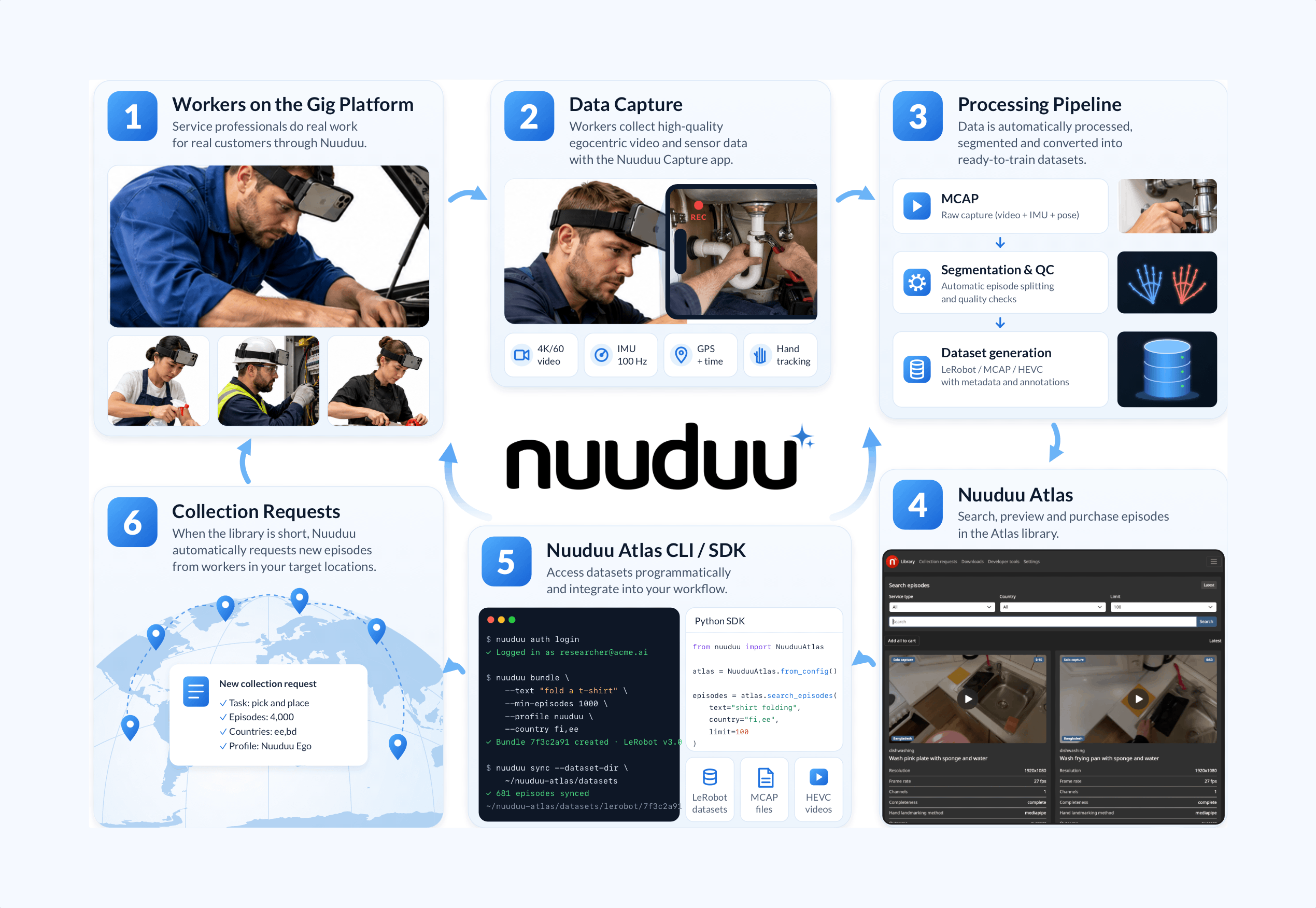
The result is a closed-loop platform combining workers, smartphone-based egocentric capture, automated processing, a searchable dataset library and developer tools that can request new demonstrations when existing data is not enough.
Real work becomes training data
At the front of the system is Nuuduu’s gig-work marketplace.
The platform covers more than 50 service categories and is built around professionals carrying out real customer assignments.
For selected work, professionals can use the Nuuduu Capture app together with a head-mounted smartphone to record egocentric video, motion and sensor data while completing the task.
That distinction matters.
Nuuduu is not trying to create a separate data-collection workforce made up of people pretending to perform tasks for a camera.
Instead, it wants the demonstration to come from someone who already knows how to do the work.
A plumber demonstrates plumbing.
A cleaner demonstrates cleaning.
A technician demonstrates technical work.
And because those professionals are already operating through the marketplace, Nuuduu can use their actual work history as part of the quality signal.
Customer ratings.
Completed assignments.
Previous performance.
Those signals can help determine which workers are suitable for a particular collection request.
The underlying idea is simple:
good robot training data should come from people who are already good at the task.
The customer is part of the loop too
Real-world physical AI data has another problem.
The environments that matter most are often exactly the environments that are hardest to reproduce in a laboratory.
Real kitchens.
Real workshops.
Real bathrooms.
Real offices.
Different homes.
Different layouts.
Different tools.
Different lighting.
Different ways of doing the same job.
Nuuduu’s model involves both the worker and the customer whose environment is being used.
The company shares revenue from training-data sales with both sides, creating an incentive for participation while also supporting the consent process required for collecting data in real homes and workplaces.
This makes the customer more than simply the person ordering a service.
The customer also provides something robotics labs often struggle to recreate:
a real environment.
From raw recording to robotics-ready data
Capturing the task is only the beginning.
Raw video by itself is not necessarily useful training data.
It has to be processed.
Segmented.
Assessed.
Annotated.
Packaged.
And converted into formats that robotics teams can actually use.
Incoming recordings are automatically processed, segmented, AI-assessed and annotated before becoming available through Nuuduu Atlas, the company’s training-data library.
The resulting data can be delivered in robotics-ready formats including LeRobot, MCAP and HEVC video.
That processing layer is what connects the human demonstration to the developer workflow.
The worker does not need to understand robotics data formats.
The robotics developer does not need to manually process every raw smartphone recording.
Nuuduu sits between them.
Atlas is the library
The public beta also brings together Nuuduu Atlas, where developers can search available training data.
The system is designed around episodes of real human work rather than generic video clips.
A developer can search for demonstrations relevant to a task.
If suitable data already exists, it can be used.
If it does not, that missing data can become a new collection request.
This is where Nuuduu begins to look less like a static dataset marketplace and more like an active data-supply system.
The complete workflow contains six connected stages:
workers performing real assignments;
data capture;
the processing pipeline;
Nuuduu Atlas;
the Atlas CLI and SDK;
and collection requests routed back to workers.
The important part is that the system forms a loop.
Developers can request the data they are missing
One of the central parts of the launch is the developer interface.
Through the Nuuduu Atlas SDK and CLI, robotics developers can programmatically search existing training data and request new demonstrations directly from their development workflows.
Suppose a robotics team discovers that a model consistently fails at a particular task.
Instead of organising a completely new collection campaign manually, the developer can identify the missing data and issue a request.
That request can then be routed to suitable workers already operating through the Nuuduu marketplace.
Those workers perform the task.
The data is captured.
The processing pipeline prepares it.
The resulting demonstrations return to Atlas.
The developer can train again.
Nuuduu describes the cycle simply:
Identify missing data → Request collection → Capture real work → AI processing → Train → Repeat.
The ambition is to shorten the time between a robot encountering a problem and a robotics team receiving the human demonstrations needed to address it.
Increasing the clock speed of physical AI
That closed loop is the central product idea behind the beta.
Robotics development increasingly happens through iteration.
Deploy.
Observe failure.
Collect better examples.
Retrain.
Deploy again.
The faster that cycle runs, the faster a model can adapt.
Nuuduu’s thesis is that the data-collection stage is still unnecessarily slow.
A robotics team may know exactly what data it needs, yet obtaining new demonstrations can still require weeks of coordination.
Nuuduu wants to compress that delay by connecting developers directly to a distributed network of professionals already performing real-world work.
Instead of repeatedly building new data-collection teams from scratch, a developer could potentially request demonstrations from people already operating in the right profession and environment.
The goal is not simply to create more data.
It is to create a faster feedback loop between robot deployment and human demonstration.
The beta brings the pieces together
Nuuduu has been building the individual parts of this system separately.
The gig marketplace.
The mobile capture applications.
The automated processing pipeline.
Atlas.
The developer tools.
The public beta is the point where those pieces begin operating as one product.
With the core platform now in public beta, Nuuduu is focusing on scaling its collection operations and worker network, expanding the initial dataset inventory and working with robotics developers to validate the complete system.
That validation will be important.
The long-term promise depends on more than each individual component working.
The full loop has to work reliably.
A developer identifies a useful data gap.
The request reaches the right worker.
The task is captured correctly.
The recording passes quality checks.
The episode is processed into a useful robotics format.
And the resulting data actually helps the robotics team.
The public beta is where that complete cycle begins to be tested in practice.
A marketplace between human expertise and machine learning
There is also a broader idea behind Nuuduu.
Most gig platforms monetise the transaction between a worker and a customer.
Nuuduu’s model attempts to create another source of value from the same work.
The professional performs the service for the customer.
But, with consent, the demonstration of that work may also become useful training material for machines learning to perform similar tasks.
The worker contributes expertise.
The customer contributes the real-world environment.
Nuuduu handles capture, processing and distribution.
The robotics developer receives a demonstration.
And revenue from the resulting training data can be shared back with the people who made the collection possible.
If the model works, physical work begins producing two outputs:
the service itself and the knowledge contained in how that service was performed.
Building the supply side before the robots need it
Nuuduu’s long-term goal is to create global infrastructure where real-world human work continuously supplies high-quality physical AI training data according to the evolving needs of robotics developers.
That is a much larger ambition than the current beta.
The company still needs to expand its worker network.
Increase the amount and variety of available data.
And prove that robotics companies actually want to integrate this collection loop into their development process.
But the architecture points toward a different way of thinking about robotics datasets.
Instead of collecting one enormous static dataset and hoping it contains everything a robot may eventually encounter, the dataset becomes responsive.
A robot fails.
A developer identifies the missing example.
The platform requests it.
A professional performs it.
The data comes back.
And the cycle begins again.
Funding the next stage
Alongside the public beta, Nuuduu is currently raising a €500,000 pre-seed round.
The funding is intended to expand the collection network, accelerate development and support commercial adoption.
For now, however, the most important milestone is simpler.
The closed loop is open for testing.
Nuuduu’s public beta brings real-world service work, egocentric capture, automated data processing, Atlas and developer-driven collection into one system.
The bet is that the future of physical AI will require more than enormous static datasets.
It will require infrastructure capable of answering a much more practical question:
when a robot encounters something it does not know how to do, how quickly can we show it?
Learn more: https://nuuduu.ai