Startup ecosystems have no shortage of conferences.
There are stages.
Panels.
Pitch competitions.
Name badges.
Carefully prepared presentations about innovation.
Vilnius Founders is trying to create something slightly different.
Its preferred description is considerably simpler:
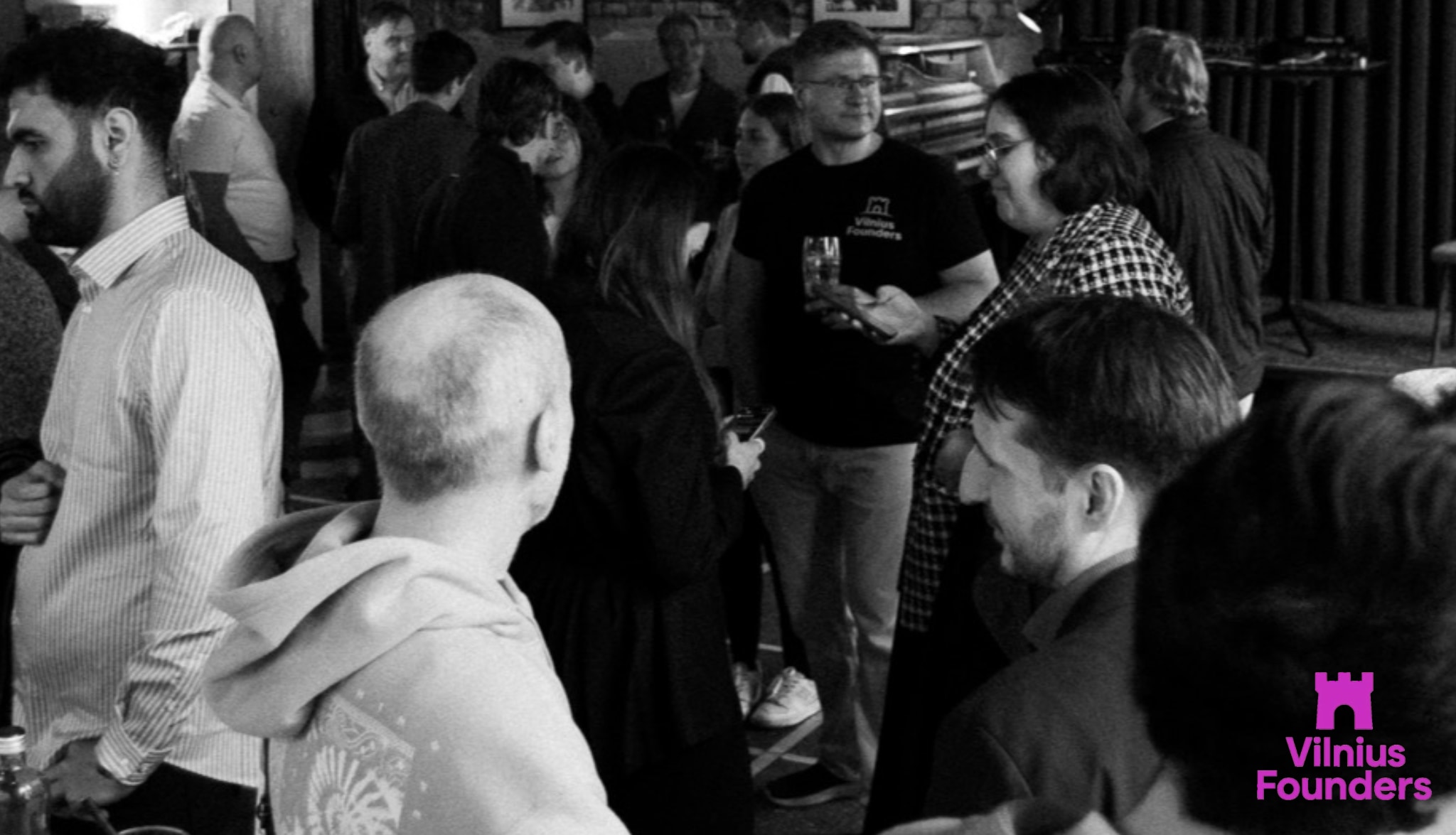
“No slides. No suits. Just honest conversations.”
Launched in 2024, Vilnius Founders is a founder-driven community bringing together startup builders, operators and investors, usually over drinks and usually around a very specific question founders are actually dealing with: how to raise money, how to enter another market, how to sell in the US, how regulation affects an AI company or what it really takes to build a defence startup.
The organisation now says it has hosted more than 33 events, reached more than 2,000 founders, reviewed over 50 pitch decks and expanded its activities across three Baltic and regional cities.
The numbers are useful.
But the more interesting part is the format.
A founder community rather than another institution
Vilnius already has a relatively developed startup infrastructure.
There are venture funds, accelerators, government programmes, university initiatives, coworking spaces and major ecosystem events.
Vilnius Founders does not really try to replace any of them.
Instead, it sits in the space between them.
The community is led publicly by Edmundas Balčikonis, founder and CEO of Such Much AI, and Vilnius Founders itself is operated through UAB Such Much AI. Its focus is explicitly founder-first: events, fundraising support, pitch-deck reviews, startup media and introductions between people already building companies.
That informality is deliberate.
The aim is less “come listen to experts explain entrepreneurship” and more “put founders, investors and operators who have actually done this in the same room.”
And the programme Vilnius Founders has assembled during 2026 shows that approach quite clearly.
From seed investment to global scale
One of its May events brought together two people representing opposite ends of the same startup story.
Donatas Keras, founding partner of Practica Capital, joined Justinas Lasevičius, co-founder of TransferGo, for From Seed to Scale.
The pairing was particularly relevant because Practica was one of TransferGo’s earliest investors.
Instead of separating the investor conversation from the founder conversation, the event examined the same company from both sides: what an investor saw at seed stage, what founders need to demonstrate when raising capital, and what changes when a startup eventually grows into a global fintech serving millions of users.
Topics ranged from pre-seed and Series A fundraising to regulated markets and the transition from a single product into a broader platform.
It is a good example of the Vilnius Founders formula.
Take a startup topic that often produces abstract advice.
Then invite people who have already lived through it.
When Brussels enters the startup room
Later that month, the community turned toward a subject founders cannot simply growth-hack their way around: European regulation.
The May 22 event How EU Policy Shapes Innovation & Startups examined the AI Act, Digital Markets Act, data regulation, European innovation funding and the broader question of whether EU regulation is helping European startups compete or making it more difficult.
Speakers included Mike Sax of ACT | The App Association, Erika Maslauskaitė of deverium and alongID, former Vilnius mayor and justice minister Remigijus Šimašius, and Danielius Stasiulis, CEO of Ogvio and a European Innovation Council board member.
Again, the angle was practical rather than academic:
What do founders actually need to care about?
What will affect the ability to launch or sell a product?
And can startups influence the rules being written around them?
For European technology companies, those questions are becoming increasingly difficult to separate from product strategy itself.
Defence tech enters the mainstream
By June, the topic had shifted again.
On June 4, Vilnius Founders organised Building and Scaling Deep Tech in Defence, supported by Iron Wolf Capital.
The speakers included Audrius Zujus, co-founder and CEO of Mainline; Vytenis J. Buzas, CEO and co-owner of Unmanned Defense Systems; and Viktoras Jucikas, general partner at Iron Wolf Capital.
The discussion focused on problems specific to defence and dual-use startups:
How do you win an early defence customer?
How do you finance companies with expensive hardware development?
What happens when sales cycles involve governments rather than SaaS subscriptions?
How do export controls, procurement and national-security considerations change the normal startup playbook?
Defence technology has moved rapidly from a relatively specialised corner of the Lithuanian startup ecosystem into one of its most strategically important categories.
Vilnius Founders’ programming has followed that shift.
Putting startups in front of investors
The organisation has also started moving beyond events alone.
Its Spring Fundraising initiative, organised together with Plug and Play Lithuania, invited Baltic startups to submit their pitch decks.
Selected companies were to be shared with more than 50 venture capital investors interested in the region, while some were invited to pitch directly during a later Vilnius Founders event.
That later gathering took place on July 2 at the new Ovoko headquarters in Tech Zity.
The event featured Liudas Kanapienis, co-founder and CEO of Ondato, and Justinas Baranovskis, co-founder and CEO of Ovoko, discussing what it takes to build global technology companies from Lithuania.
More than 300 founders, investors and startup builders were expected, alongside ten startup pitches from teams representing Lithuania, Latvia and Poland.
This starts to reveal a broader ambition.
The community is not just trying to create pleasant evenings for founders.
It is trying to turn the network itself into useful infrastructure.
Vilnius Founders leaves Vilnius
Perhaps the clearest evidence of that came two weeks later.
On July 16, Vilnius Founders held its first Warsaw edition, bringing Lithuanian and Polish founders, investors and operators together on the Vistula river.
Supported by Inovo VC and Market One Capital, the event focused on go-to-market strategy and fundraising in the AI era. Speakers represented both founders and regional venture investors.
More than 260 people attended the first Warsaw event.
That is an interesting development for something still called Vilnius Founders.
The name may be local.
The network increasingly is not.
For Baltic startups, Warsaw is an obvious connection point: a much larger domestic market, an increasingly important venture ecosystem and a natural gateway into Central Europe.
Creating those connections directly between founder communities may ultimately be more useful than trying to construct another formal cross-border institution.
Then came Vinted
The August 19 event brought the conversation back to one of Lithuania’s defining startup stories.
Milda Mitkutė, co-founder of Vinted, joined an evening focused on go-to-market strategy and international expansion, organised with BADideas.fund.
Mitkutė discussed Vinted’s early years, the search for product-market fit, building trust and community, and the process of taking a company created in Vilnius into major European markets.
She was joined by Mario Araujo, Head of Product-Led Growth at Flosum, and BADideas.fund founder Raimonds Kulbergs, bringing the discussion from founder history into practical questions around product-led growth, activation, retention and international GTM.
More than 600 people registered for the event, according to BADideas.fund.
For a community started only in 2024, that is a useful signal that the format has found an audience.
The startup event without the startup-event feeling
The easiest way to misunderstand Vilnius Founders would be to see it simply as another event organiser.
Events are what people see.
But the actual product is probably the network around them.
A founder meets another founder.
An investor sees a company they had not previously encountered.
Someone preparing a US expansion meets somebody who has already done it.
A first-time founder hears what went wrong rather than only hearing the polished version of what went right.
A Lithuanian startup meets a Polish investor.
A defence engineer meets a VC comfortable funding hardware.
Those connections are difficult to measure.
They are also one of the main reasons startup ecosystems exist.
Vilnius Founders seems to understand that the value of a startup event often begins after the official programme ends.
Less ecosystem theatre
Vilnius Founders uses a phrase on its own website that probably explains the organisation better than any formal mission statement:
“Less ecosystem theatre. More useful people in the same room.”
There is a little intentional provocation in that.
Startup ecosystems can become very good at talking about startup ecosystems.
More programmes.
More panels.
More reports explaining how innovative everyone is.
Vilnius Founders has chosen a simpler model.
Find people who have built something.
Find people currently building something.
Add investors and operators who might actually be useful.
Give them a topic worth discussing.
Then give them enough time to talk to each other.
It may not sound particularly revolutionary.
Perhaps it does not need to be.
As Lithuania’s startup ecosystem matures, founders increasingly need something different from basic encouragement to start companies.
They need access to experience.
Capital.
Customers.
International networks.
And other founders who have already encountered the problem they are about to discover.
That is the gap Vilnius Founders is trying to fill.
And judging by its increasingly crowded rooms in 2026, quite a few founders seem to think that gap is real.
Check out upcoming Vilnius Founders events: https://vilniusfounders.lt/events
Photo credit: Paulius Žižliauskas