
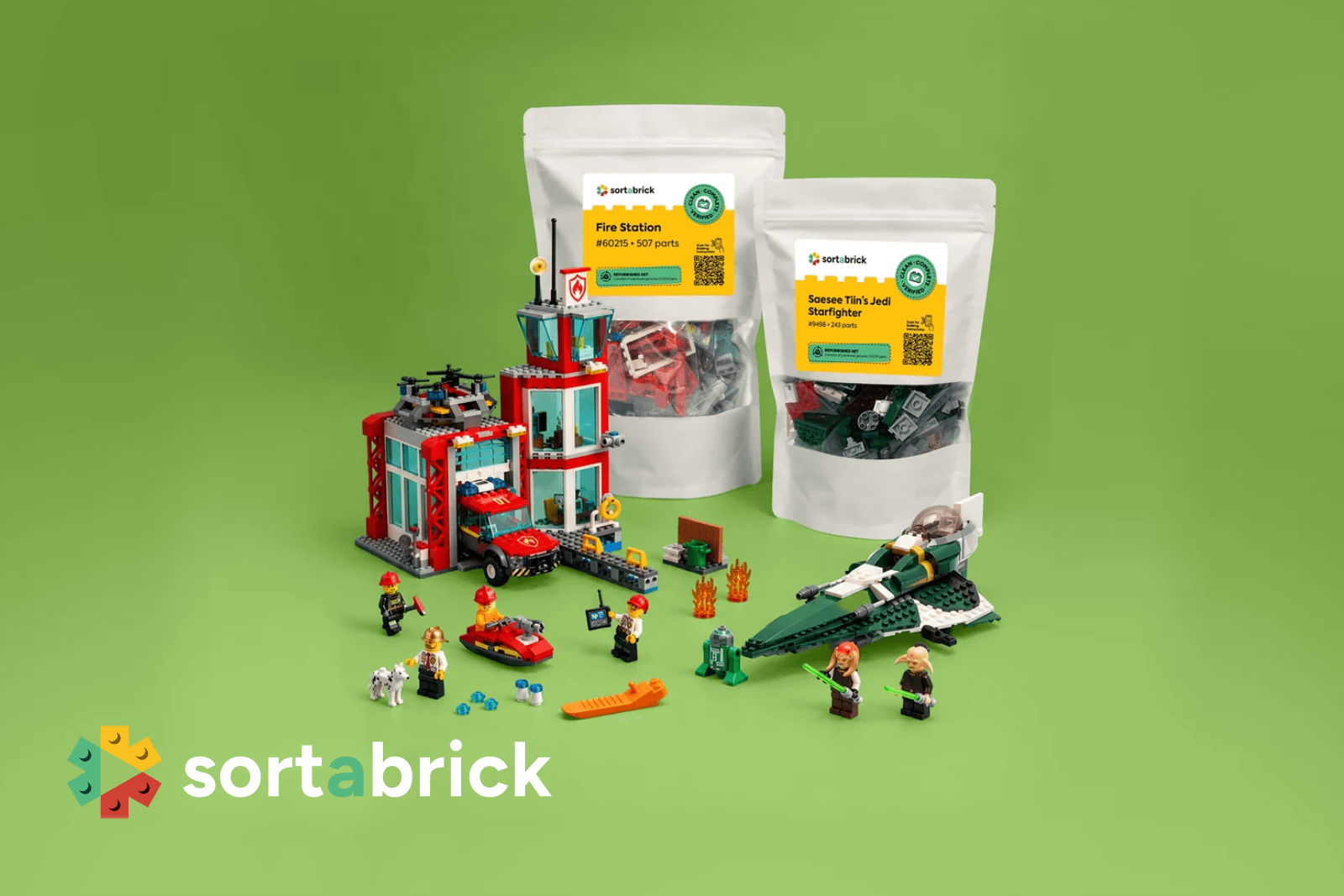
Almost every family that has owned LEGO® bricks eventually encounters the same problem.
The sets disappear.
The bricks do not.
A spaceship becomes part of a castle.
A castle becomes part of a car.
Instructions disappear.
Pieces migrate between boxes.
And after enough years, what once cost hundreds or thousands of euros becomes a large container of mixed plastic sitting under a bed or in a cupboard.
The bricks are still perfectly usable.
The value is still there.
But recovering it manually can require hours — or days — of sorting.
Lithuanian startup Sort A Brick is building a machine for that problem.
What began as an idea for automatically sorting mixed LEGO bricks is evolving into something considerably larger: industrial refurbishment infrastructure for second-hand toys.
The company uses proprietary computer vision, physical AI and purpose-built industrial machinery to identify, clean and sort mixed bricks, determine which original sets can be reconstructed, source missing pieces and turn old collections back into complete, verified, ready-to-build products.
And in autumn 2026, the model is entering a new stage.
Sort A Brick is no longer only offering to restore customers’ collections.
It is launching a marketplace for refurbished LEGO sets, bringing buying, restoration and selling under the same platform. Public sales of its first batches are scheduled to begin on October 1.
The bigger ambition is becoming clear:
make used toys refurbishable at industrial scale.
It started with a box of bricks
The idea came from an extremely ordinary family problem.
One of the co-founders was confronted with thousands of his son’s mixed LEGO bricks and the tedious task of sorting them.
There had to be a better way.
That question eventually became Sort A Brick. The Lithuanian company was founded in 2023, with Ilya Malkin and Aurimas Slapšys among its founding team. Today the operating company, UAB BR1CK, is based in Lithuania and runs its processing operation from Terminalo Street in Kaunas district, while the company also identifies Vilnius as its headquarters and operates facilities there.
The initial proposition was easy to understand.
Send in a box of mixed bricks.
Sort A Brick cleans them.
Its system identifies the individual pieces.
Software works out which sets can be rebuilt from the collection.
Missing parts can be added.
The customer gets usable sets back instead of a box of chaos.
It sounds almost trivial.
The engineering required to make it economical is not.
Humans are very bad at sorting 100,000 kinds of pieces
LEGO’s strength as a product creates the problem Sort A Brick is trying to solve.
The system is extremely standardized.
Pieces manufactured years apart can still fit together.
Sets contain hundreds or thousands of small components.
Many pieces look almost identical.
Some differ only by a tiny geometric feature.
Others differ by colour, print or generation.
Sort A Brick says its technology must work across more than 100,000 unique LEGO part types. One of its current physical-AI systems is being trained using more than 500 high-resolution images per part.
A human can identify bricks.
But humans are expensive, slow and inconsistent when asked to identify millions of them one by one.
That creates the economic bottleneck.
Second-hand LEGO already has value.
The difficulty is turning unsorted inventory into something a buyer can confidently purchase.
A box of random bricks is one product.
A complete, cleaned and verified retired LEGO set is a much more valuable one.
The missing step is industrial processing.
Computer vision meets a conveyor belt
Sort A Brick’s answer is not just an AI model.
It is a physical system.
Bricks move through purpose-built machinery where cameras capture them and computer-vision models identify what each piece is.
Software connects those recognised parts to an inventory.
That inventory can then be matched against the parts required for thousands of possible sets.
The machinery physically separates the pieces so they can eventually be assembled into complete collections.
Sort A Brick describes the technology as a combination of proprietary machinery, physical AI, data and software operating as one integrated system.
This distinction matters.
There are many impressive computer-vision demonstrations.
The difficult part is making one work reliably inside an industrial process, repeatedly, with enough speed and low enough cost that the economics make sense.
Sort A Brick says its upcoming second-generation sorter is designed to process approximately one part per second, increase capacity around fivefold and reduce sorting costs by almost three times compared with its earlier system.
That is the line between a clever hobby project and industrial automation.
The real product may be refurbishment
At first, Sort A Brick could easily be described as a LEGO sorting service.
That description is becoming too narrow.
The company’s current positioning is:
“The refurbishment infrastructure for toy re-commerce at global scale.”
That changes the way to look at the technology.
Sorting is not the final product.
Sorting is one step in a larger refurbishment pipeline.
Bricks come in.
They are cleaned.
Inspected.
Identified.
Inventoried.
Matched to possible sets.
Missing pieces are sourced.
The set is completed.
Its contents are verified.
And the finished product becomes ready to build — or ready to sell.
This is much closer to what already happens with refurbished phones, computers or industrial machinery.
The difference is that the underlying product consists of hundreds or thousands of tiny plastic components.
Sort A Brick is effectively asking:
if we can refurbish an iPhone, why can’t we refurbish a LEGO set?
Used does not have to mean uncertain
Second-hand marketplaces have made it easy to buy almost anything from another person.
But they introduce uncertainty.
Is every piece there?
Are the bricks clean?
Are some damaged?
Is the seller’s description correct?
Will the set arrive and turn out to be 95% complete?
For a complex building set, that missing 5% can destroy the experience.
Sort A Brick is trying to create a different category between new and randomly used.
Its refurbished-set proposition is built around three promises:
clean, complete and verified.
The company can take mixed bricks from multiple sources, reconstruct the original set, replace missing parts and then sell the result as a standardized refurbished product.
That standardization may be the commercially important part.
Re-commerce becomes much easier to scale when the buyer does not have to evaluate the reliability of every individual seller.
Missing pieces create their own logistics problem
Reconstructing sets from old collections rarely produces perfect inventories.
A piece was lost under a sofa ten years ago.
Another ended up in somebody else’s collection.
One broke.
One disappeared into a vacuum cleaner.
If Sort A Brick promises a complete set, somebody has to find those missing pieces.
The company says it has already purchased more than 110,000 individual replacement parts, many from independent BrickLink sellers, with thousands of pieces arriving at its Vilnius operation each week.
This reveals another layer of the business.
Artificial intelligence can identify what is missing.
It cannot teleport the missing brick into the box.
At scale, refurbishment becomes a supply-chain problem.
Which parts are missing most often?
Which should be held in inventory?
Which should be sourced externally?
How do you economically purchase hundreds of tiny components from many sellers?
How much inventory should be held before the working capital becomes too expensive?
The more the company grows, the more this logistics system can become part of its competitive advantage.
Demand arrived before capacity
One of the more unusual problems Sort A Brick has faced is not finding customers.
It is processing them fast enough.
The company’s current public profile reports more than 1,600 bookings from 40 countries and over 30,000 kilograms of bricks waiting in the queue.
Earlier fundraising material described demand as running roughly 50 times ahead of monthly capacity, with more than 1,000 families already waiting and tonnes of bricks queued for restoration.
By mid-2026, founder Ilya Malkin said the operation had moved to three shifts and was running 24 hours a day, seven days a week, yet at then-current capacity the backlog would still take years to clear.
That is an unusual startup bottleneck.
A SaaS company can often respond to a surge in customers by buying more computing capacity.
Sort A Brick has to build machines.
Improve throughput.
Organise shifts.
Handle physical inventory.
Expand floor space.
And make every processing step faster.
Its growth therefore resembles manufacturing as much as software.
€1.15 million to industrialise the idea
Investors have been willing to fund the transition.
In 2024, Sort A Brick raised €1.15 million in a round backed by Baltic VC FIRSTPICK, business angels and the founders’ own capital.
Among the investors were well-known Lithuanian technology operators including Mantas Mikuckas, one of the founders of Vinted, alongside other angels and technology investors.
The capital was aimed at developing the technology and expanding operations, including the company’s initial commercial launch in Germany.
The investment thesis was broader than simply building a clever sorting robot.
Millions of valuable bricks already exist.
They are durable.
They are standardized.
And enormous quantities sit unused because the cost of sorting and reconstructing them exceeds what most families are willing to spend in time.
Automation potentially changes that equation.
LEGO is an unusually good place to start
If someone wanted to build infrastructure for toy refurbishment, LEGO is close to an ideal first category.
The pieces are highly standardized.
They are durable.
Individual components can be identified.
Original set inventories are known.
The product has strong emotional value.
It also retains unusually high monetary value compared with many other toys.
Some sets become collectible.
Retired sets can become more expensive rather than less.
And a set manufactured years ago can still be perfectly usable today.
That creates an unusually large gap between the value of the material and the value of the unsorted object.
A pile of mixed bricks may look like clutter.
The exact same pieces, cleaned and reconstructed into complete sets, can be worth hundreds or thousands of euros.
Sort A Brick exists in that gap.
The circular-economy story is unusually literal
Many companies describe themselves as part of the circular economy.
With Sort A Brick, the loop is easy to see.
A family buys a set.
The child builds it.
It gets dismantled.
The bricks are mixed with others.
Years pass.
Instead of producing another new set from new plastic, the existing bricks are cleaned, identified, reorganised and put back into use.
The company says its mission is to bring billions of neglected bricks back to life.
The environmental argument is helped by the physical characteristics of the product.
LEGO bricks are extraordinarily durable.
That durability is a waste problem when pieces are discarded.
It is an asset when they can be reused.
The challenge has never been whether the bricks survive.
The challenge is recovering them economically.
The business is now becoming a marketplace
The company’s latest move makes the broader strategy much clearer.
Sort A Brick has brought three activities together:
buy refurbished sets;
restore your own collection;
sell unused bricks to Sort A Brick.
This creates the beginnings of a closed-loop system.
Someone who has no interest in rebuilding their old collection can sell the bricks.
Sort A Brick can process them.
Its systems determine what can be reconstructed.
Missing parts are sourced.
The finished sets enter the refurbished marketplace.
Another family buys them.
What had been dead inventory in one household becomes a usable product in another.
The company plans releases of new batches of refurbished sets every two weeks, with the first public sales under its new storefront beginning in October 2026.
That means Sort A Brick is no longer dependent only on people paying to have their own collections sorted.
It can increasingly become the merchant itself.
AI is useful because the physical economics require it
There is a tendency for almost every startup today to describe itself as an AI company.
Sort A Brick is an interesting counterexample because the need for AI is unusually concrete.
Without automated recognition, the economics are difficult.
If people have to identify every individual brick manually, labour dominates the refurbishment cost.
If computer vision can identify those pieces reliably and machinery can process them quickly, the cost curve changes.
The AI does not exist to make the product sound modern.
It exists to remove a human task that otherwise prevents the business model from scaling.
That applied approach was recognised in the 2025 European AI Awards, where Sort A Brick was named a winner in the AI Business category.
In 2026, it also won the Harvard Business School Alumni New Venture Competition for Europe & International.
For a startup working on what initially sounds like an oddly specific problem, those awards signal that the technology and business model are being viewed more broadly.
A small company building an industrial operation
Sort A Brick is still small.
Public Lithuanian records show UAB BR1CK with around 16 employees in 2026. The same records show the company is still firmly in its investment stage rather than operating as a mature profitable business.
That matters when looking at the current scale claims.
This is not yet a giant refurbishment factory.
It is a deep-tech startup trying to build one.
Its current constraint is precisely the thing it is inventing: the machinery and process capable of handling enough physical volume at sufficiently low cost.
The next-generation sorting system, expanded processing capacity and new recommerce platform are all parts of solving the same problem.
Can an operation that today processes tonnes eventually process hundreds or thousands of tonnes?
LEGO may only be the first category
The most interesting question is what happens if the infrastructure works.
Sort A Brick currently starts with LEGO because it is an unusually attractive refurbishment category.
But the company’s own positioning is no longer limited to bricks.
It describes itself as building refurbishment infrastructure for toy re-commerce at global scale.
That implies a larger thesis.
Second-hand marketplaces solved one part of re-commerce:
they made it easy for a buyer and seller to find each other.
They did not solve refurbishment.
For many categories, a used product still needs to be inspected, cleaned, identified, repaired, completed, graded or repackaged before it becomes a trustworthy standardized product again.
Today much of that work is manual.
If physical AI and industrial automation can perform more of it economically, re-commerce can move beyond peer-to-peer listings.
The future second-hand marketplace may look less like a classified-ad site and more like a reverse factory.
Products come in disorganised.
Machines understand what they are.
The system restores their value.
And they go back out as standardized products.
The sorter was only the beginning
The original Sort A Brick idea could be explained in one sentence:
send us your mixed LEGO bricks and a machine will sort them.
Three years later, that no longer captures the company.
It has developed proprietary computer vision.
Built industrial sorting machinery.
Created a cleaning and inventory process.
Developed software for reconstructing sets.
Built supply chains for missing pieces.
Accumulated tens of tonnes of customer inventory.
Moved operations toward 24/7 processing.
And is now launching a marketplace for verified refurbished sets.
The machine still matters.
But the real opportunity surrounding it has become much larger.
Sort A Brick is trying to turn what was previously an economically impractical pile of used pieces into standardized inventory.
If it succeeds, the company will have built more than a LEGO sorter.
It will have demonstrated something much more interesting:
that physical AI can make refurbishment itself scalable.
And that could turn the boxes of forgotten toys sitting in millions of homes from waste into something much closer to inventory waiting to be rediscovered.