
It is late in the evening before a court hearing.
A lawyer needs to understand how the Supreme Court has recently ruled on reducing contractual penalties, which earlier rulings still apply and how those decisions relate to the facts of the case in front of her.
She can spend hours searching legal databases.
Or she can ask a general-purpose AI assistant and receive a polished answer in seconds.
The problem is that the answer may also confidently cite a case that does not exist.
That gap is what Vilnius-based Vasara was built to solve.
Rather than asking lawyers to trust artificial intelligence, Vasara is built around a simpler principle:
every legal answer should be checkable.
The Lithuanian legal-tech startup is now preparing its first expansion outside Lithuania, with a soft launch in Poland planned for October 2026.
The approach is deliberately cautious.
Vasara is not promising a flawless AI lawyer.
It is not claiming that hallucinations can somehow be eliminated forever.
And it is not trying to replace the person whose name ultimately appears on the legal document.
Instead, it wants to give lawyers something far more practical:
AI that shows its sources.
“In law, fluency without a source is a liability”
General AI tools have become remarkably good at producing convincing legal language.
That is also what makes them dangerous.
A badly written answer is easy to distrust.
A beautifully written answer containing a fabricated court ruling is much harder.
In many industries, a confident but incorrect AI answer is an inconvenience.
In law, it can become part of a court filing, transaction or compliance decision — and the lawyer signing the document remains responsible.
Vasara’s answer to that problem is not to tell lawyers that the AI cannot make mistakes.
It is to make the output verifiable.
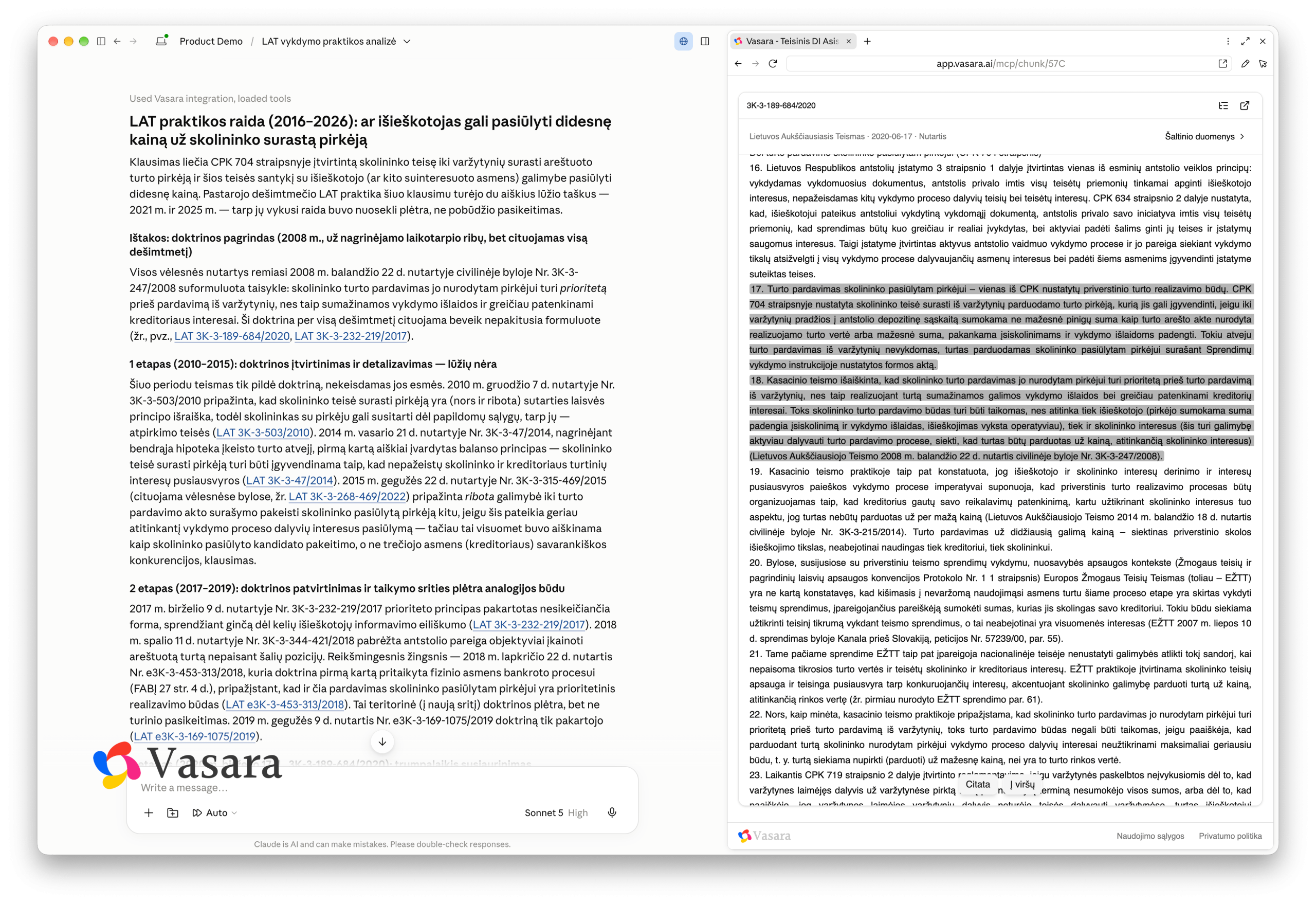
The system retrieves relevant legal material and points the user back to the exact act, ruling, institutional commentary or passage supporting the answer.
If the available sources do not support a conclusion, the desired behaviour is not to improvise.
It is to say so.
As the founders put it:
“We can’t promise the AI never makes a mistake. We can promise you’ll always see where the answer came from.”
That distinction sits at the centre of the product.
Vasara works with the AI lawyers are already using
Vasara is not trying to persuade lawyers to abandon ChatGPT, Claude or Copilot.
The founders assume lawyers will use those tools anyway.
Instead, Vasara is building legal infrastructure around them.
Its tools provide verified legal context that can be used inside or alongside major AI assistants, allowing lawyers to work with familiar interfaces while grounding their work in applicable legislation, case law and other legal sources.
That also changes how Vasara approaches international expansion.
Rather than rebuilding a large standalone legal platform separately for every country, it can enter a jurisdiction more incrementally.
For Poland, that means starting connector-first.
Polish lawyers can use Vasara together with the AI environments and documents they already work with, while Vasara gradually expands the Polish legal source base and validates it with practising local lawyers.
The language model itself is not the differentiator.
The legal context is.
As Vasara puts it:
“Big tech builds the engine. We make sure it knows the law.”
More than legal research
Research is only one part of the workload Vasara wants to address.
Legal professionals routinely work with enormous volumes of information.
Thousands of pages of contracts.
Scanned documents.
Due-diligence materials.
Corporate records.
Court files.
Regulatory documents.
Structured information that needs to be extracted from hundreds or thousands of files.
General AI tools can perform impressively on individual documents, but heavy professional legal work introduces a different class of problem.
Vasara says its customers currently save the most time in three areas:
legal research, legal document analysis and drafting certain types of documents.
The platform is designed to handle larger document sets, scanned files and structured extraction workflows used in due diligence and legal audits.
That positions Vasara less as a legal chatbot and more as a set of professional AI tools built around how lawyers actually work.
It started as an attorney’s side project
Vasara did not begin with a startup pitch deck.
It began as a side project.
In the early days of retrieval-augmented AI, Karolis Racevičius, a licensed attorney, began experimenting with ways to automate legal work together with another lawyer.
They built a prototype.
Then they showed it to roughly a dozen lawyers.
The response was encouraging enough to expose the next problem.
Building something useful was not the same as building a company around it.
Turning the prototype into a commercial product required sales, product strategy, positioning and go-to-market execution.
In autumn 2025, Racevičius met Martynas Nikolajevas, a serial technology entrepreneur with experience building companies.
The match was unusually complementary.
Racevičius understood the legal profession from inside.
Nikolajevas understood how to turn a working product into something customers would buy.
They co-founded Vasara at the beginning of 2026.
The first paying customer arrived by the end of January.
As the founders describe it:
“Karolis knew the problem from the inside. Martynas knew how to turn a prototype into a product people pay for. Neither of us could have done it alone.”
More than 200 lawyers in the first months
The early traction came quickly.
Within roughly seven months, and with a team consisting of just the two co-founders, Vasara grew to more than 200 lawyers in Lithuania using its paid products.
Customers include law firms NOOR and TRINITI JUREX.
The public sector has also begun using the technology, with customers including the Office of the Government of Lithuania and the Ministry of Finance.
For an early-stage startup, those are particularly demanding customers.
Legal firms and government institutions are not usually known for adopting unproven technology simply because it is fashionable.
That makes the speed of adoption meaningful.
As the founders put it:
“Law firms and government institutions are probably the most conservative buyers out there. When they start paying for something within weeks, it tells you the problem is real.”
Why Poland?
After proving the first version of the model in Lithuania, Vasara is now preparing its first international test.
Poland is the obvious candidate.
According to the company, the Polish legal market is roughly 13 times the size of Lithuania’s and represents the largest legal market in Central and Eastern Europe.
It also has a large and increasingly digital legal profession.
Most importantly, the behavioural change Vasara observed in Lithuania is already happening there.
Lawyers are experimenting with AI.
The question is changing from:
Should lawyers use artificial intelligence?
to:
Can lawyers trust what artificial intelligence tells them?
That is precisely the problem Vasara has spent its first months solving.
Not a full-scale launch
Vasara is careful about describing what happens next.
October 2026 is a soft launch, not a full-scale Polish rollout.
The startup is beginning with a small group of practising Polish lawyers and plans to run its first customer-acquisition tests.
At the same time, it is building the Polish legal source base and using local lawyers to identify where the difficult jurisdiction-specific nuances are.
This matters because law cannot simply be translated from one language to another.
Each jurisdiction has its own legislation.
Its own case law.
Its own institutions.
Its own legal terminology.
Its own interpretive traditions.
And often its own assumptions that are obvious to a local practitioner but invisible to somebody approaching the jurisdiction from outside.
Vasara therefore does not claim that a Lithuanian startup understands Polish law better than Polish lawyers.
It wants Polish practitioners involved in identifying precisely where the system needs local depth.
It is not training a Polish legal model
There is another important distinction in Vasara’s approach.
The company is not training or fine-tuning its own language model for every jurisdiction.
Modern language models are already extremely capable at understanding and producing language.
Vasara sees the difficult legal-tech problem elsewhere.
What information is the model using?
Is the law applicable?
Is the source current?
Can the lawyer inspect it?
Can the system connect the answer to the actual material rather than simply relying on what the model happens to remember?
In that architecture, entering Poland is less about teaching an AI to speak Polish and more about building the reliable legal context surrounding it.
The model may understand the question. The source base has to understand the jurisdiction.
Keeping the law current is continuous work
Legal information also has an unusual property:
it changes.
Parliaments amend legislation.
Courts reinterpret rules.
New judgments clarify earlier ones.
European Union legislation affects national law.
Regulators issue guidance.
An AI system grounded in an excellent legal database that was updated once and then forgotten would quickly become a bad legal system.
Vasara therefore treats source maintenance as continuous infrastructure.
The founders deliberately avoid claiming “real-time” legal updates.
Their point is simpler: a legal AI system is only as current as the material it can retrieve.
Maintaining those sources is not a launch task that eventually ends.
It is part of the product.
And as Vasara expands across jurisdictions, that local source layer increasingly becomes the difficult part of the business.
Lawyers are not necessarily sceptical about AI
One assumption about the legal profession is that lawyers are inherently resistant to artificial intelligence.
Vasara’s experience has been more nuanced.
Many lawyers are already using it.
The scepticism is directed elsewhere.
They are wary of AI they cannot verify.
That distinction is especially important for the Polish launch.
Vasara does not need to convince every Polish lawyer that ChatGPT exists or that large language models can draft text.
Many already know.
The commercial question is whether Vasara can make those tools sufficiently useful and trustworthy for professional work.
This gives the startup an unusual position.
General AI adoption can actually help it.
The more lawyers use Claude, ChatGPT or Copilot, the more obvious the missing legal infrastructure becomes.
Competing with big tech by not competing with big tech
There is little point in a two-person Lithuanian startup trying to build a better general-purpose language model than the world’s largest technology companies.
Vasara is not attempting to.
Its strategy assumes that the underlying AI engines will continue becoming better.
OpenAI can improve ChatGPT.
Anthropic can improve Claude.
Microsoft can develop Copilot.
Vasara benefits from those improvements while concentrating on the layer those companies are unlikely to solve deeply for every individual Central European jurisdiction:
local legal sources;
local language;
local workflows;
local legal practice;
and pricing appropriate for the firms that make up much of the CEE legal market.
That is also how Vasara differentiates itself from larger international legal-AI platforms.
Global products can concentrate on the world’s largest law firms and most commercially valuable jurisdictions.
Vasara sees an opportunity in going deeper locally.
Lawyers remain responsible
Perhaps the most important design principle is also the least futuristic.
The lawyer remains the decision-maker.
Vasara is not positioned as an autonomous lawyer.
It does not remove professional responsibility.
It does not turn a generated answer into legal truth.
Instead, it tries to reduce the amount of mechanical work between a legal question and the lawyer’s own informed judgment.
Find the relevant decisions faster.
Analyse the documents faster.
Draft the first version faster.
Show exactly which sources support the answer.
Then let the professional decide.
This is a very different promise from replacing lawyers.
The aim is to make the lawyer’s checking process faster without pretending that checking has become unnecessary.
Poland as a test for a much bigger idea
The Polish launch is important for reasons beyond Poland.
Lithuania gave Vasara an environment in which the founders could build quickly, work closely with early users and prove that professional legal customers would pay.
Poland tests whether that model travels.
The founders say Lithuania taught them three things:
lawyers buy trust, not features;
local sources are the hard part;
and
a small team can move extremely quickly when it listens closely to users.
If the same approach works in a market roughly 13 times larger, it could become the template for expansion elsewhere in Central and Eastern Europe.
The company is already hiring for go-to-market and partnership roles in Poland, with the expectation that a local team will eventually grow around the market.
What success looks like a year later
Vasara is deliberately not defining the Polish launch through a large headline market-share target.
A year after launch, the founders want something more fundamental.
Polish lawyers using Vasara every week in real legal work.
A substantially broader Polish legal source base.
A local team.
And evidence that the product has become part of lawyers’ normal workflow rather than something they experimented with once because AI was fashionable.
That would validate more than one market.
It would validate the company’s expansion model.
The prototype was not the company
There is also a classic startup story hiding inside Vasara.
One attorney begins experimenting with retrieval-augmented AI.
A dozen lawyers say they want it.
A commercial co-founder arrives.
The first customer pays in January.
Within months, more than 200 lawyers are using paid products.
Before the company’s first year is complete, it is preparing to enter a neighbouring market roughly thirteen times larger than the one in which it started.
All with two co-founders.
That illustrates an important distinction in startups.
The prototype is not the company.
The prototype proved the problem could be solved technically.
The company had to prove that lawyers cared enough to change their behaviour and pay for the solution.
Poland is the next test.
Legal AI does not need to be believed
Artificial intelligence has created a strange new problem for professional knowledge work.
The output can sound more certain than the underlying evidence deserves.
In law, that is particularly dangerous.
Vasara’s approach is almost deliberately unromantic.
Do not ask the lawyer to believe the AI.
Show the lawyer the source.
That principle helped a two-person Vilnius startup reach more than 200 paying legal professionals in its first months.
In October 2026, Vasara will begin testing whether the same proposition works in Poland.
The ambition is larger than building another legal chatbot.
Vasara wants to become the trusted legal layer sitting between increasingly powerful general-purpose AI systems and the professionals who are accountable for what those systems produce.
Or, in the company’s own words:
“Legal made simple, for humans.”