
Most companies spend enormous amounts of money trying to generate demand.
Advertising.
Content.
SEO.
Events.
Sales teams.
Lead-generation agencies.
Then somebody finally fills in a form.
And nothing happens.
Perhaps a salesperson calls the next morning.
Perhaps an automated email arrives.
Perhaps the lead sits untouched in a CRM until somebody has time.
By then, the person who was interested may already have spoken to a competitor.
Vilnius-based Outcraft AI is built around the idea that many companies do not actually have a lead-generation problem. They have a lead-handling problem.
The startup is building autonomous AI sales agents that react to customer intent immediately — calling, texting, emailing or messaging people on WhatsApp, holding conversations and continuing the follow-up until something actually happens.
A demo gets booked.
An abandoned checkout becomes a purchase.
A failed payment gets recovered.
A customer considering cancellation stays.
Or the conversation is passed to a human salesperson with the context already collected.
Outcraft calls itself an AI sales team for inbound demand.
The important word may be team.
It does not want to simply give companies another AI tool.
It wants the AI to do the work.
The expensive few minutes after someone says “I’m interested”
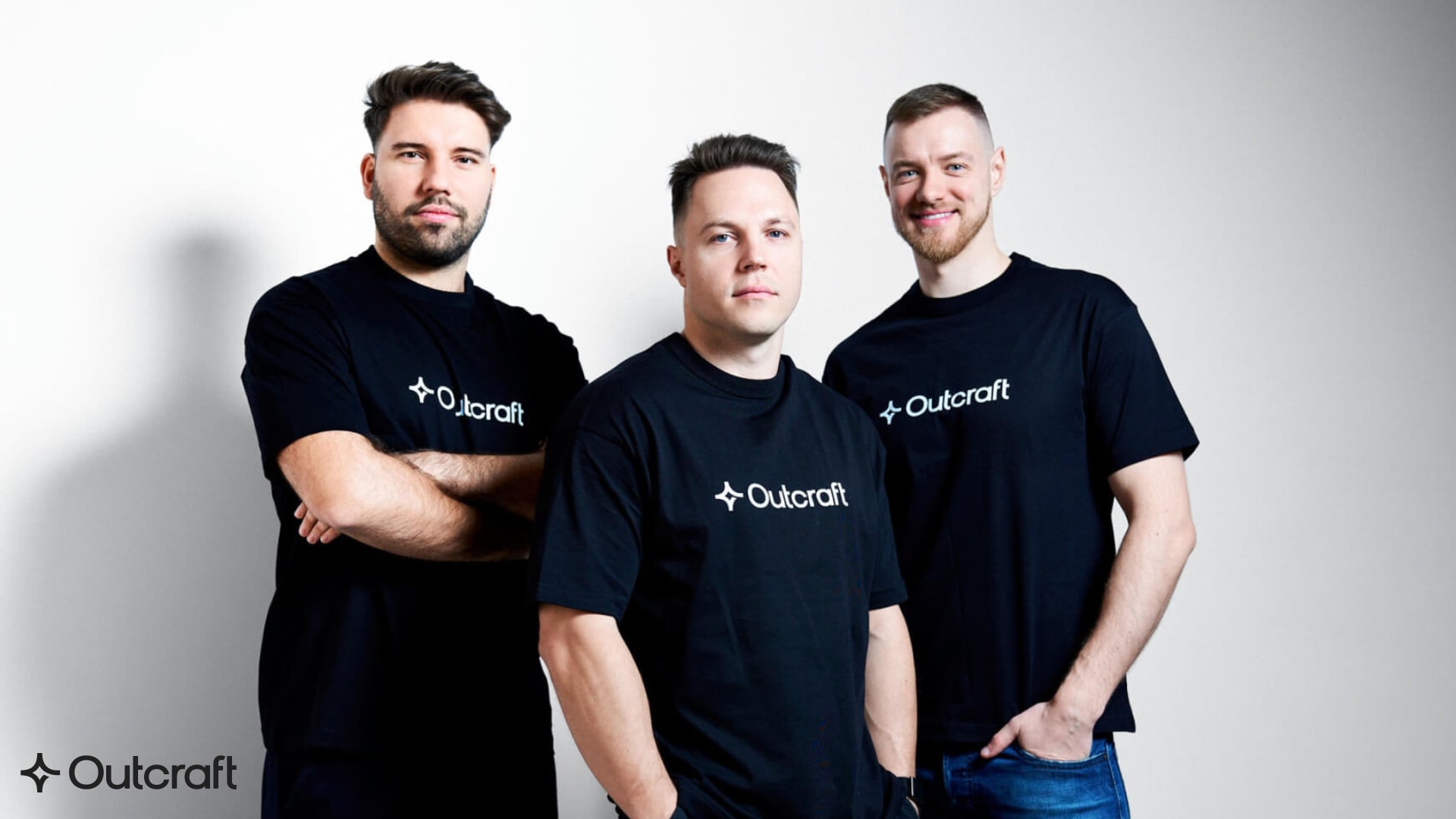
Outcraft was founded in 2025 by Will Nauseda, Edvinas Rakickas and Rytis Dereškevičius.
The founders came at the same problem from different directions.
Nauseda had worked as VP of Sales and Chief Commercial Officer at software companies. At email-deliverability platform Warmy, he was responsible for a sales organisation facing a familiar problem: new trial users were arriving, but a small human sales team could not contact every one of them immediately.
Rakickas had built Nextus.ai, a lead-generation agency that generated large numbers of prospects for clients.
That experience produced a somewhat uncomfortable insight.
Companies were paying to generate more leads while already losing many of the leads they had.
Rakickas later described the problem simply: most companies do not have a lead problem — they have a lead-handling problem. Leads are contacted too slowly, buyers lose interest and acquisition spending is wasted.
Dereškevičius brought the technical side. An experienced software engineer and former lead engineer at Hostinger, he had also previously co-founded the online design platform Wizlogo.
Together, the three started building what became Outcraft.
The first customer was effectively the founder himself
One of the more convincing aspects of the Outcraft origin story is that the original problem was not invented for a pitch deck.
Nauseda wanted the product while running sales.
Warmy became an early deployment.
Before Outcraft, its human SDR team was booking roughly three to five sales meetings per week from incoming free-trial users.
Outcraft began contacting new users within minutes of signup.
The AI could call them.
If they did not answer, it could follow up by email or SMS.
If the person was interested, it could qualify them and book a meeting directly into the calendar.
According to Outcraft’s case study, weekly booked meetings increased to roughly 18–22, while trial-to-demo conversion improved by around 15%.
The underlying number of incoming leads had not suddenly increased.
The company simply began talking to far more of them while their interest was still fresh.
That became the core thesis behind Outcraft:
intent has a short half-life.
Not another chatbot
The easiest way to misunderstand Outcraft is to imagine a chatbot with a phone number.
Its ambition is broader.
Outcraft connects to systems a business already uses — CRM platforms, e-commerce systems, payment infrastructure and marketing tools.
It watches for events.
A new demo request appears in HubSpot.
Someone starts a Shopify checkout and abandons it.
A Stripe payment fails.
A trial user stops engaging.
A customer indicates they may cancel.
Those events become triggers.
Outcraft then decides what to do next.
Perhaps call.
Perhaps send a text first.
Perhaps email.
Perhaps move the conversation to WhatsApp.
And the same interaction can continue across those different channels rather than becoming four unrelated automation sequences.
The platform currently advertises more than 20 native integrations, including Salesforce, HubSpot, Shopify and Stripe. It supports voice conversations in more than 40 languages and regional dialects.
That distinction matters.
Traditional automation generally follows rules.
If this happens, send this email.
Wait two days.
Send another email.
Outcraft wants the agent to read the response, understand what happened and decide the next action dynamically.
The unit of automation becomes the conversation, not the message.
Voice changes what automation can do
Email automation has existed for decades.
SMS automation is hardly new either.
What makes the current generation of systems different is the rapid improvement in real-time voice AI.
A phone conversation contains much more uncertainty than an automated email.
The person asks a question.
Interrupts.
Objects to the price.
Changes subject.
Says they are busy.
Wants to know whether the product supports a particular feature.
Asks for Tuesday instead of Wednesday.
A traditional phone-tree system breaks quickly.
Outcraft says its voice agents are designed to hold real-time conversations, answer product questions and respond to objections rather than simply reading predetermined scripts.
This creates an interesting new possibility.
Until recently, giving every e-commerce shopper or SaaS trial user a personal phone call would have been economically absurd.
A company might have thousands of abandoned carts.
Hiring people to telephone every one of them would cost more than the recovered sales were worth.
AI changes that equation.
Suddenly, every abandoned cart can theoretically get a salesperson.
Calling someone who abandoned a shopping cart sounds strange — until it works
Outcraft is applying the same model beyond B2B software.
For an e-commerce company, the signal may not be a demo form.
It may simply be a customer who reached checkout and disappeared.
Perhaps their card failed.
Perhaps they were confused about delivery.
Perhaps they had a product question.
Perhaps they became distracted.
Traditional e-commerce systems respond with an abandoned-cart email.
Outcraft can respond with a conversation.
One of its early customers is Lithuanian wellness-technology company Pulsetto.
Outcraft says its agents have been used for abandoned-checkout recovery, post-purchase upsells and customer-education calls. According to an Outcraft case study, these workflows have produced more than $100,000 in recurring monthly revenue, with reported ROI above 30× over a six-month period.
Those figures come from Outcraft’s own customer reporting, but they illustrate why investors are interested in the category.
If an AI product can be connected directly to revenue recovered, its value becomes much easier to measure than that of a general-purpose productivity assistant.
Omnisend meets the channel it did not already have
Another early customer is Omnisend, one of Lithuania’s best-known global SaaS companies.
Omnisend already specialises in automated e-commerce communication through channels such as email and SMS.
Outcraft adds another layer.
Customer behaviour inside Omnisend can become a trigger for AI-driven conversations through voice and other messaging channels.
An audience segment changes.
Purchase intent appears.
A customer stops engaging.
A repeat-purchase opportunity emerges.
The signal already exists.
Outcraft acts on it.
Omnisend’s Director of Sales and Partnerships Marty Bauer has described the system as a “force multiplier” for the company’s go-to-market team, allowing its human BDRs to spend more time on higher-value work while AI handles repetitive initial engagement.
That framing is important because Outcraft is not positioning itself simply as a way to fire the sales department.
Humans still get the difficult conversations
There is an obvious fear around AI sales agents.
If the AI becomes capable of calling leads, qualifying them, answering questions and booking meetings, what happens to salespeople?
Outcraft’s own positioning is more nuanced.
The company argues that AI is particularly good at the first conversation at scale.
Every lead gets contacted.
Every abandoned cart can receive attention.
Every failed payment can be followed up.
The agent does not forget.
It does not finish work at 17:00.
And it does not decide that the twentieth lead of the afternoon can probably wait until tomorrow.
But Outcraft itself says there are limits.
For niche, complicated or high-value opportunities, a properly briefed human can still be the better salesperson.
The AI’s role is increasingly to make sure that human gets the opportunity at the right moment — already qualified and with the earlier conversation attached.
The division of labour becomes:
AI handles scarcity of attention. Humans handle complexity.
A €2 million pre-seed round
In April 2026, only months after the company was founded, Outcraft announced a €2 million pre-seed investment led by Practica Capital.
The company had previously received early backing from venture builder Lost Astronaut.
Practica highlighted two things in particular: Outcraft’s vision for lean revenue teams, where a very small human team can operate a large inbound-sales motion, and the fact that the startup had already attracted substantial customers while still operating largely in stealth.
The capital is being used for product development, go-to-market expansion and entry into additional markets.
A €2 million pre-seed round is significant for a company this young.
But the timing is also significant.
Outcraft is entering one of the most crowded areas in software.
Everyone is building agents.
The AI-agent market has a differentiation problem
It is now remarkably easy to demonstrate an AI agent.
Connect a language model.
Add a voice provider.
Give it access to some company information.
Make a phone call.
The demo can be impressive.
Building a business around it is harder.
Outcraft therefore makes a deliberate distinction between itself and voice-agent builders such as Bland, Synthflow or Retell.
Those products provide infrastructure from which a company can build an AI calling system.
Outcraft wants to sell the completed workflow.
The customer should not need to design every conversational branch, connect the voice tool to the CRM, build follow-up automation and then decide how success is measured.
Outcraft wants the instruction to be closer to:
When somebody requests a demo, turn them into a qualified meeting.
Or:
When somebody abandons checkout, try to recover the sale.
The underlying calls, emails, SMS messages, integrations and decisions become implementation details.
Success is measured in booked meetings or recovered revenue rather than call minutes.
That is potentially a much more defensible position.
The value is no longer the fact that an AI can talk.
It is whether the system can reliably accomplish a commercial objective.
The salesperson who responds in ten seconds
For years, sales software was mostly software used by salespeople.
CRMs stored opportunities.
Sales-engagement platforms scheduled emails.
Diallers helped people make more calls.
Analytics tools showed managers what the team was doing.
AI agents introduce a fundamentally different category.
The software itself becomes a participant in the sales process.
A person requests a demo at 23:47.
Nobody is working.
Ten seconds later, their phone rings.
The voice on the other end knows which product they were looking at.
It answers their initial questions.
Determines whether the company is a good fit.
And books a meeting with a human account executive the following morning.
Nobody had to notice the lead.
Nobody had to create a task.
Nobody had to remember to follow up.
The CRM has moved from being a database of things humans should do into a source of signals that machines can act upon.
Building for the moment companies already paid to create
There is something particularly attractive about Outcraft’s business logic.
It is not primarily promising to create demand out of nowhere.
The customer already did the expensive part.
They bought the advertising.
Created the content.
Built the product.
Generated the traffic.
Convinced somebody to visit the website.
And persuaded that person to demonstrate intent.
Outcraft focuses on what happens immediately afterwards.
That makes its core proposition unusually easy to understand:
do not spend money creating an interested customer and then lose them because nobody responded.
The company was founded only in 2025.
Its €2 million pre-seed round arrived in April 2026.
It is still extremely early.
And the market for AI agents is moving so quickly that today’s technological advantage can disappear in months.
But Outcraft has already found a useful place to draw the boundary around the problem.
Not AI for sales.
Not a better chatbot.
Not another voice API.
Instead:
the moment a customer raises their hand, make sure someone answers — even when that someone is software.
Find out more at: https://www.outcraft.ai