
Most drones are designed to see what is happening above ground.
Broswarm wants them to see what is underneath it.
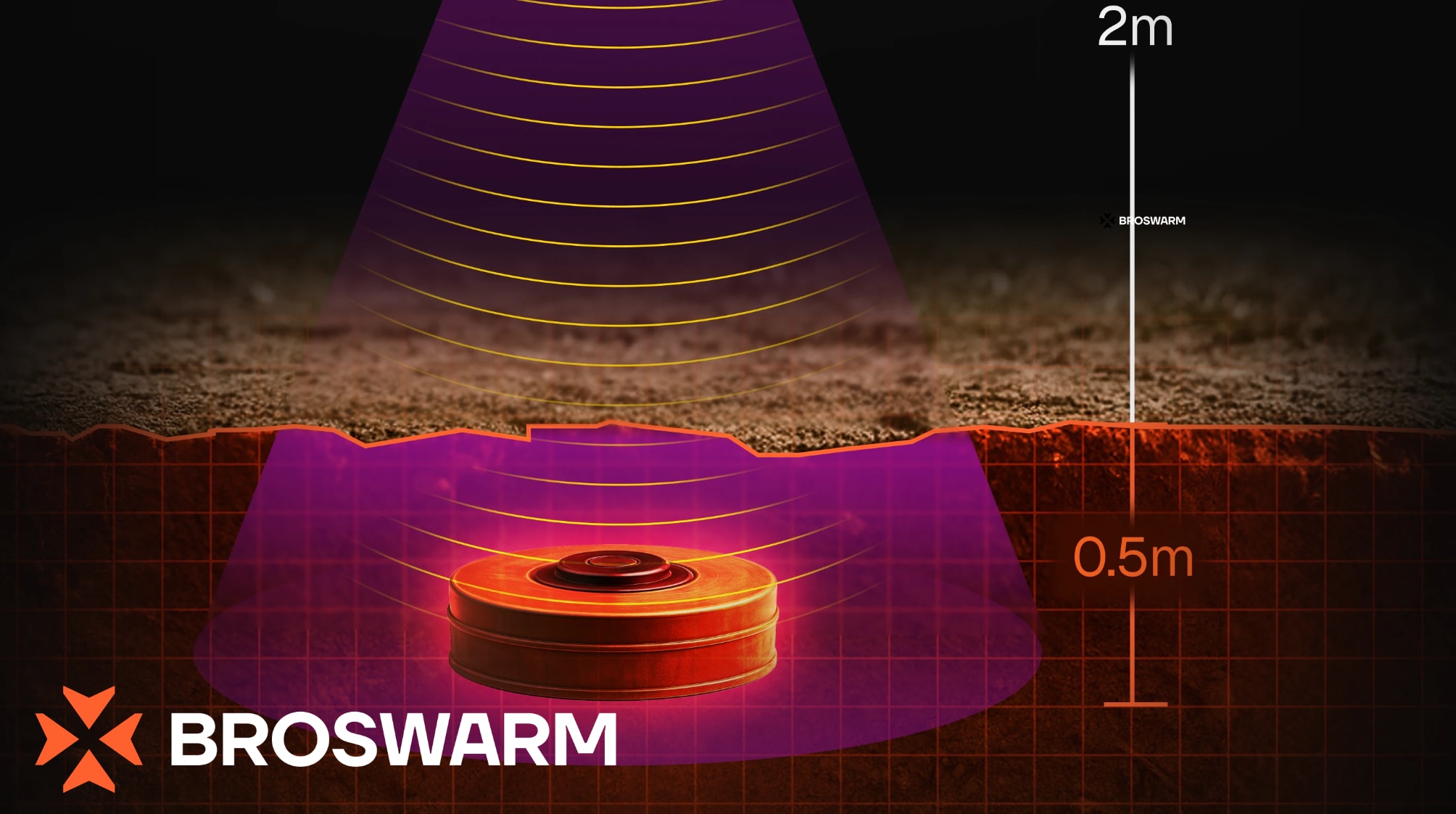
The Vilnius-based defence technology startup is developing a lightweight airborne radar system designed to detect and visualise objects buried beneath the surface. Its first and most urgent application is one of the world’s most difficult detection problems: finding landmines without first sending a person into the minefield.
Founded in 2023, Broswarm has moved quickly from an early concept combining drones, sensors and artificial intelligence toward developing its own radar technology. The company has won a NATO innovation competition, attracted several rounds of investment and, in December 2025, tested the first version of its radar together with the Lithuanian Armed Forces. Testing in Ukraine is planned as the technology moves closer to real-world deployment.
The problem is not simply finding metal
Traditional mine detection remains a difficult and inherently dangerous process.
A metal detector can identify metal in the ground, but not every mine contains enough metal to make that approach reliable. Modern explosive devices can contain substantial amounts of plastic and other non-metallic materials, while conflict zones are simultaneously full of harmless pieces of metal.
Ground-penetrating radar provides another way of looking below the surface, but conventional systems often operate close to the ground and can require equipment or people to enter the area being examined.
Broswarm’s basic proposition is therefore straightforward: move the sensing equipment into the air.
Instead of requiring a person or vehicle to physically cross potentially contaminated ground, the company wants a drone to scan the terrain remotely and identify suspicious objects beneath it.
That sounds simple. Technically, it is anything but.
From a drone company to a radar company
Broswarm’s early descriptions focused heavily on combining drones, multiple sensors and machine learning.
The company has since concentrated increasingly on the sensor itself.
At the centre of its current platform is X-SAR, Broswarm’s proprietary airborne radar payload. The company describes it as a lightweight synthetic aperture radar system engineered specifically for drone deployment.
Synthetic Aperture Radar, or SAR, normally creates high-resolution imagery by combining radar measurements collected from different positions as the sensor moves.
Broswarm is applying that principle underground.
Its X-SAR architecture combines synthetic-aperture techniques with aerial ground-penetrating radar. According to the company, the approximately 2 kg payload operates in the 1–6 GHz range and is designed to detect both metallic and plastic-cased buried objects. Radar measurements gathered during flight are reconstructed into multidimensional representations of what lies beneath the surface.
In other words, the goal is not merely to make a detector beep when something suspicious is underneath the drone.
The ambition is to create something closer to underground vision.
Building a three-dimensional picture
This distinction matters.
Knowing that something is beneath a particular point is useful. Knowing its approximate shape, depth and position is considerably more useful.
Broswarm says its processing system uses a physics-based spatial reconstruction algorithm to combine the radar data into three-dimensional representations. Its current platform is also intended to provide Z-axis information, allowing an operator to understand not only where an object is horizontally, but where it sits beneath the surface.
The system is designed around more than the radar payload itself.
Broswarm presents X-SAR as drone-agnostic, meaning the sensor is intended to work as a payload rather than forcing users to adopt a proprietary aircraft. The wider platform includes an operator station, RTK positioning equipment and a handheld tablet through which detected underground objects can be viewed and tracked on a map.
That could prove important commercially.
Military units, governments and humanitarian organisations already operate different drone fleets. A sensor that can be integrated onto existing suitable aircraft has a very different deployment path from a system requiring an entirely new drone ecosystem.
Born from the war in Ukraine
Broswarm was created in 2023 after Russia’s full-scale invasion of Ukraine pushed its founders toward a problem none of them had previously built a business around.
CEO and co-founder Ernestas Žvaigždinas has described the project as emerging from the question of whether their technical and entrepreneurial experience could be applied to something useful in response to the war.
He was joined by his brother Karolis Žvaigždinas, now CTO, whose background spans technology, machine learning, hardware and software, and engineer Mindaugas Talaikis. More recent company and investor material also identifies Ramūnas Augulis as part of the founding team.
It was an unusual move for a team without a previous background in defence.
But the company found traction quickly.
In 2023, Broswarm was one of the winners of Lithuania’s Flaming Shield defence innovation event. The following year came a much larger piece of external validation.
Winning the NATO Innovation Challenge
In July 2024, Broswarm took first place in the NATO Allied Command Transformation Innovation Challenge.
The competition focused on remotely recognising and neutralising areas contaminated with explosive threats. Broswarm’s approach beat international competitors and put the young Lithuanian company directly in front of one of the world’s most important defence organisations.
Winning an innovation challenge does not prove that a technology will work at scale in operational conditions.
But for a startup barely a year old, it provided something extremely valuable: validation that the problem and the proposed technical direction were being taken seriously by potential users.
Broswarm has since received further recognition from Lithuania’s defence technology community and continued developing the system beyond the original concept.
From a laboratory concept to military testing
The harder milestone is making the technology work outside a presentation or controlled laboratory.
By late 2025, Broswarm had reached that stage.
According to CEO Ernestas Žvaigždinas, the first version of the company’s radar was tested with the Lithuanian Armed Forces in December 2025. The company is now working on a second version using an array of radars rather than a single radar unit.
The next major step is Ukraine.
Broswarm is preparing to test the technology there, where the conditions are considerably closer to the problem it was originally founded to solve.
That transition is particularly important for defence technology.
A sensor that performs well on a prepared test site still has to contend with different soils, vegetation, debris, terrain, weather and the enormous variety of objects buried in real environments.
Ukraine provides perhaps the most demanding possible environment in which to discover whether the technology can make that transition.
Investors are backing the attempt
The project has also attracted a growing amount of private capital.
In March 2024, Lithuanian defence-focused investor ScaleWolf invested $100,000 in Broswarm. Later that year, ScaleWolf backed the company again with an additional €800,000 investment as development shifted toward Broswarm’s proprietary radar technology.
More recently, Broswarm secured another €409,000 from an NGL Ventures syndicate involving 61 business angels. The new capital is being directed toward further radar development, the second-generation system and additional testing.
For a small Lithuanian deep-tech company, that progression is significant.
Broswarm is no longer raising money solely around an idea of combining existing sensors and drones. It is financing the development of proprietary sensing hardware and the algorithms required to turn radar measurements into usable underground imagery.
Bigger than landmines
Landmine detection remains Broswarm’s defining mission, but the underlying technology could ultimately have applications beyond demining.
A lightweight airborne system capable of identifying and reconstructing underground objects could potentially be useful anywhere organisations need to inspect the subsurface without physically traversing it.
That could include military mobility and force protection, unexploded ordnance detection and, eventually, certain civilian inspection and infrastructure applications.
For now, however, the landmine problem gives Broswarm a brutally clear benchmark.
The technology either helps identify dangerous buried objects reliably enough to improve the way contaminated land is surveyed — or it does not.
That makes field testing far more important than another demonstration video.
A Lithuanian deep-tech story worth watching
Lithuania has become increasingly visible in drones, lasers, sensors and other dual-use technologies.
Broswarm sits at an interesting intersection of all of them.
It is building hardware, radar technology, signal processing and software around an unmanned platform, while targeting a problem with both immediate military importance and potentially decades of humanitarian consequences after wars end.
And its evolution over only a few years is notable.
The company began with the broad idea of using drones, sensor fusion and AI to improve mine detection.
It is now building its own radar.
It has moved from hackathons to NATO recognition, from prototypes to testing with the Lithuanian military, and from early venture funding toward the far more difficult stage of proving the technology in real environments.
The ultimate vision is easy to understand even if the engineering required to achieve it is extraordinarily difficult:
before a person has to step onto dangerous ground, send a machine to look underneath it.
That is the problem Broswarm is trying to solve.