
Almost every growing company runs into the same problem.
Someone in the organisation knows exactly how to perform a particular process. How to create a report in the ERP system. How to configure a new customer. How to process a return. How to complete one of the hundreds of everyday tasks that nobody formally teaches.
The problem begins when that knowledge needs to be transferred to someone else.
You can write instructions. Take dozens of screenshots. Record a Loom video. Create slides. Or simply jump on another call and show everything to the new colleague again.
Guideless wants doing the process once to be enough.
The Lithuanian AI startup watches what a user does in their browser and automatically turns those actions into structured, editable training material with AI-generated narration.
At first glance, it may look like a simpler way to create instructions.
But Guideless has a much bigger long-term ambition: to capture how an organisation actually works and turn that knowledge into a continuously updated operational memory for the company.
The problem: everyone knows documentation matters, but nobody wants to do it
Process documentation is not a new problem.
Companies already have Notion, Confluence, Google Docs, internal knowledge bases and countless other tools.
Yet the documentation process itself usually remains manual.
An employee has to stop what they are doing, remember every step, describe those steps, take screenshots and explain why each action is performed.
And then the software interface changes.
The button in the instructions has moved. The process now has an additional step. The old screenshot no longer reflects reality.
Documentation starts becoming outdated almost from the moment it is created.
Guideless founder Evaldas Bieliūnas describes the problem very practically in the company’s own writing: processes inside companies are often scattered across documents, Slack, Notion and people’s memories, and employees frequently find it easier to ask a colleague again than to search for an outdated instruction.
Guideless is trying to change not where documentation is stored, but how it is created.
Just do your job
Guideless works through a browser extension.
The user starts recording and simply performs the process exactly as they normally would.
Clicks buttons.
Opens menus.
Moves from one page to another.
Enters information.
Guideless captures that sequence of actions and automatically turns it into individual instructional steps. AI writes the explanations and can generate narration, subtitles, highlights and zooms.
The result can be edited, shared through a link, embedded into a company’s knowledge base or exported as a video.
This is where one of the biggest differences from a conventional screen recording appears.
Guideless does not simply create one continuous video file.
The process is broken down into individual structured steps.
If one part of the process changes, there is no need to record the entire training video again. A single step can be replaced, moved or updated.
That is why Guideless positions itself not only as an alternative to Loom, but also as an alternative to traditional SOP documentation, screenshots and manually maintained knowledge bases.
Demonstrate it once — teach it in many languages
Another obvious advantage of this model appears in international organisations.
A person can demonstrate the process once.
Guideless can use that same structured process to generate training material in different languages, using AI-generated voices.
The platform currently supports narration in more than 40 languages.
That changes the economics of producing training material.
If a company has employees in ten countries, the traditional approach may require ten different sets of instructions or ten localised videos.
In the Guideless model, the underlying structured process remains the same.
Only the way it is presented changes.
From Vinted experience
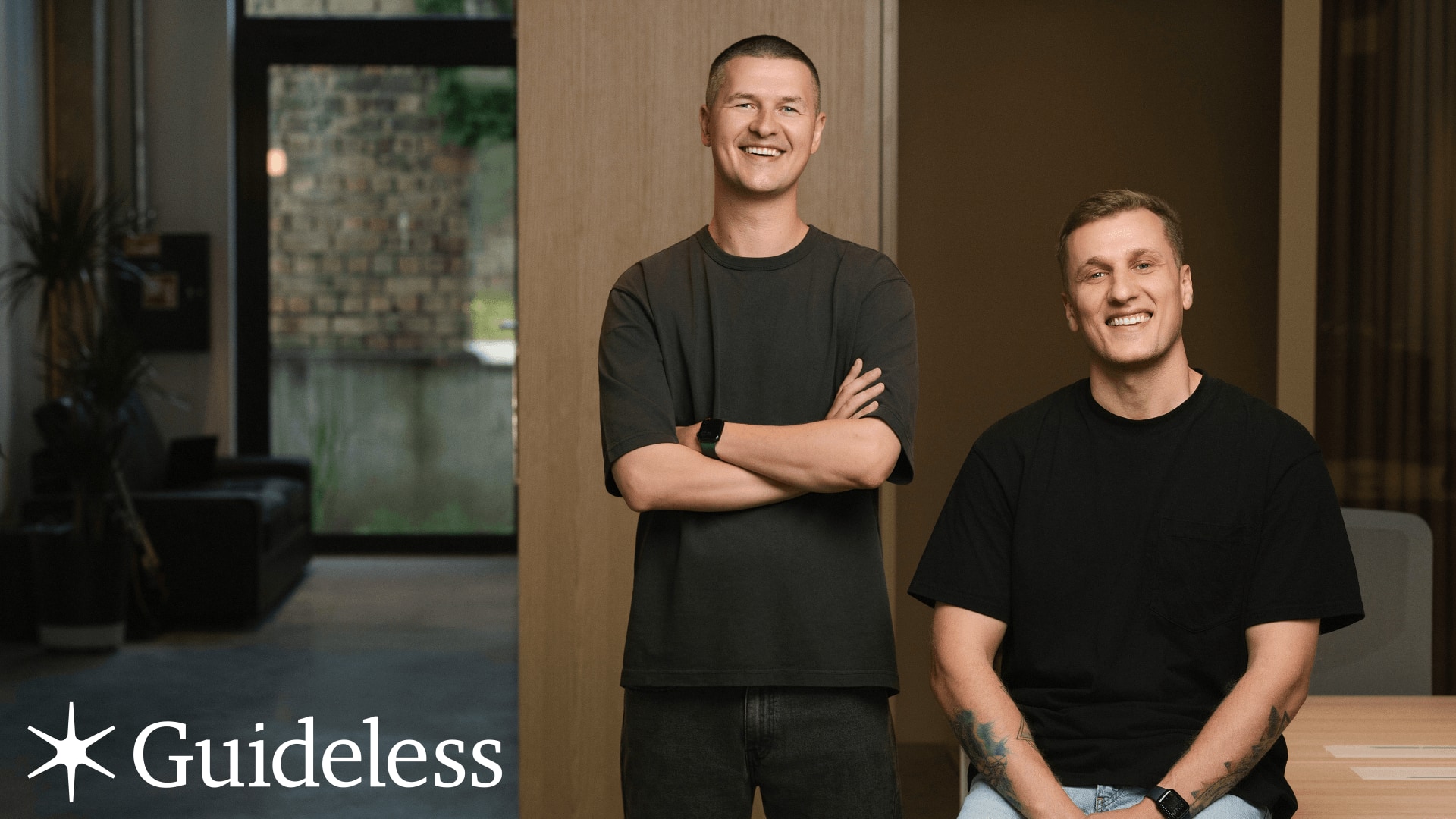
Guideless was founded by Evaldas Bieliūnas and Dovydas Remeika.
Bieliūnas spent more than a decade working with SaaS businesses and scaling commercial teams, and before founding Guideless served as Director of Business Development at Vinted Go.
Remeika spent more than a decade building business software for banks and large organisations.
That background is important to understanding the idea behind the product.
Guideless did not emerge purely from a theoretical belief that AI could write better instructions.
Bieliūnas has spoken about seeing first-hand, while managing commercial teams and onboarding employees across different countries, how much time organisations lose teaching people to use internal systems and repeatedly explaining the same processes.
The team began quietly introducing Guideless to the market in late 2025, while the legal entity itself was established in June 2026.
And the product found users relatively quickly.
More than 3,000 users before the major funding round
In August 2026, Guideless announced a €1 million pre-seed investment.
By then, the platform already had more than 3,000 users, paying customers across 15 markets, and was being used by organisations including Vinted, Masan Consumer Holdings and the Nevada Hospital Association, alongside hundreds of other companies.
That matters for one reason.
The investment did not arrive on the strength of a pitch deck alone.
According to Bieliūnas, the company had not even formally started a fundraising process. Investor interest appeared after Guideless already had a working product and initial customers.
The round was led by Finnish venture capital fund Superhero Capital, with Lithuanian fund FIRSTPICK also participating. The angel investors included three names particularly familiar to Lithuania’s technology ecosystem:
Thomas Plantenga, CEO of Vinted Group,
Vytautas Atkočaitis, CEO of Vinted Go,
and Mantas Mikuckas, one of Vinted’s co-founders.
That is particularly interesting because Vinted itself was one of Guideless’ early users.
Plantenga has described seeing the platform transform the way a large company knowledge base was maintained: work that could previously take weeks following user-interface changes can be updated far more quickly using Guideless.
But instructions may only be the beginning
Perhaps the most interesting part of Guideless is not what the product does today, but what the structure it captures could eventually represent.
When an employee demonstrates a process, Guideless receives more than a video.
The system receives a sequence:
this page was opened;
this object was then selected;
this action was performed;
and then the user moved to the next step.
That is already a structured description of how work is performed inside an organisation.
And this is where the product begins to intersect with another rapidly growing area of technology: AI agents.
For an AI agent to perform work inside a company, it is not enough for it to understand what an invoice or a CRM system is.
It needs to understand how this particular company performs a particular process inside its own systems.
Guideless investors have already highlighted this aspect of the technology: every captured workflow could become not only an instruction for a person, but also context that future AI agents can use.
That is a much bigger vision than an automated training-video generator.
Organisational memory
Imagine a company with a thousand employees.
Thousands of small processes exist inside it.
Some are documented.
Some are documented incorrectly.
Some exist in old videos.
Some are known only by one employee.
And some are written down nowhere because “everyone just knows how it’s done.”
As long as those people remain at the company, the system somehow continues to function.
When someone leaves, part of the organisation’s knowledge leaves with them.
Guideless’ long-term goal is to become an operational memory layer that preserves and continuously updates information about how work is performed inside a company, even as employees, software and the processes themselves change.
Such a knowledge base can train new employees.
It can train customers.
It can help partners.
And eventually, it can provide context to AI agents.
The same underlying source of knowledge — for different kinds of users.
One million euros for the next stage
Guideless plans to use its new €1 million investment for product development, team expansion and international growth.
The company has identified the United Kingdom, other European markets and the United States as priority markets.
It is a logical product category for international expansion.
Guideless does not require local physical infrastructure.
The problem it addresses is not uniquely Lithuanian.
If a company uses software and employs more than a handful of people, somebody has to explain how its processes work.
The larger the organisation becomes, and the more frequently its systems change, the more expensive that problem becomes.
Recording knowledge, not the screen
At first glance, Guideless can be described very simply:
turn on the browser extension, perform a process and receive a polished, narrated instruction.
That is already a useful product.
But there is a much more interesting idea underneath it.
For years, companies have tried to document their knowledge by asking people to describe what they do.
Guideless is trying to capture that knowledge simply by watching the work being done.
If the idea succeeds, the result may be more than a better tool for creating instructions.
It could become a continuously updated map showing how an entire organisation actually operates.
And in a world where the same processes will increasingly be performed not only by humans but also by AI agents, that map could become far more valuable than another folder full of SOP documents.