
Every time a bank account is opened online, a cryptocurrency exchange accepts a new customer or a marketplace needs to know who is standing on the other side of a transaction, somebody has to answer a deceptively simple question:
Is this person actually who they claim to be?
For nearly a decade, a company from Kaunas has been building technology to answer it.
iDenfy started with a relatively narrow mission: verify people’s identities online and stop fraudsters using stolen payment cards.
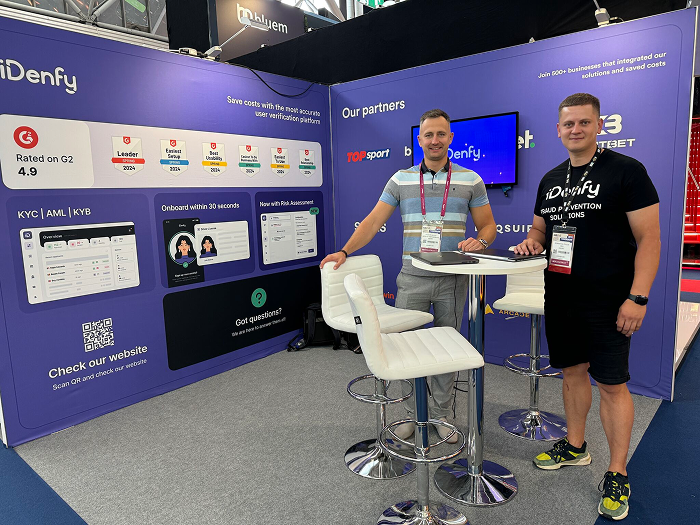
Today it has developed into a broader RegTech platform covering identity verification, business verification, anti-money-laundering screening and fraud prevention. The company says more than 1,000 businesses use its technology, with identity verification supported across more than 200 countries and territories. Its headquarters remain in Kaunas, while it also maintains a presence in the United Kingdom and the United States.
But perhaps the most interesting thing about iDenfy is the problem it has spent nine years chasing.
As identity verification technology improves, so do the people trying to defeat it.
Fake documents become better.
Stolen identities become easier to trade.
Generative AI produces increasingly convincing faces and documents.
Deepfakes improve.
And the system responsible for deciding whether somebody is real has to improve again.
iDenfy is effectively building technology for a permanent arms race over trust on the internet.
It started with stolen credit cards
The origins of iDenfy go back to a problem CEO Domantas Čiuldė encountered before the company formally existed.
Čiuldė has described working at a UK-based internet-security business protecting companies against DDoS attacks, cyber intrusions and data leaks. Yet one problem kept appearing that conventional server security could not solve: transactions made using stolen credit cards.
Around 2015, Čiuldė and his friends began looking for a way to prevent that kind of fraud.
Their conclusion was simple: if you could reliably establish who was actually behind a transaction, many forms of fraud became considerably harder.
They began studying computer vision and machine learning and built an early identity-verification prototype.
It was primitive by today’s standards.
It could recognise only Lithuanian passports.
Yet that prototype was enough to attract an early investment. According to Čiuldė, those investors also became some of the product’s first customers, giving the team both capital and a real-world environment in which to develop the technology.
iDenfy was formally established in Kaunas in 2017. An early profile of the company identified childhood friends Domantas Čiuldė and Gediminas Ratkevičius as the pair who started it, with Laimonas Sutkus subsequently joining the early core team as CTO.
The internet needs a passport desk
Identity verification is one of those pieces of infrastructure most users notice only when it becomes annoying.
A service asks you to photograph your passport.
Then take a selfie.
Turn your head.
Look into the camera.
Wait.
What sits behind those few seconds, however, is a surprisingly difficult technical problem.
A verification system needs to determine whether the identity document itself is genuine.
It needs to extract and validate the information printed on it.
It needs to determine whether the face appearing in front of the camera corresponds to the person in the document.
It also needs to determine whether that face belongs to a live human being rather than a photograph, video replay, mask or increasingly sophisticated AI-generated fake.
And it has to do all of that without making legitimate customers abandon the onboarding process.
iDenfy now says its system can work with more than 16,000 types of government-issued identity documents across more than 200 countries and territories. Its platform combines document analysis, facial biometrics and 3D liveness detection with other fraud-prevention checks.
Essentially, iDenfy is attempting to build the digital equivalent of an extremely fast border-control desk that businesses can embed inside their own products.
AI alone was never the entire answer
One of the more interesting decisions in iDenfy’s development came relatively early.
While identity-verification companies were increasingly trying to automate the entire process, iDenfy concluded that automation alone was not reliable enough.
So it added humans back into the loop.
Automated systems analyse documents and biometric information first, while iDenfy also operates an internal team of trained reviewers who can inspect verification results. The company says this hybrid approach has remained a core part of its product since its early years.
That sounds almost counterintuitive for an AI company.
But identity verification has an unusual asymmetry.
If a system wrongly rejects a legitimate user, the customer has a bad experience.
If it wrongly approves a sophisticated fraudster, the consequences can involve stolen money, money laundering, regulatory penalties or access to an account under a false identity.
The objective therefore is not simply maximum automation.
It is reliable automation with somewhere for uncertainty to go.
As artificial intelligence makes fraud more sophisticated, that hybrid model may become more important rather than less.
From KYC to an entire compliance stack
The company itself has also changed.
Originally, iDenfy was primarily an identity-verification business.
Today its product range extends much further.
Alongside traditional Know Your Customer (KYC) identity checks, the platform provides Know Your Business (KYB) tools for verifying companies and their owners, AML screening, sanctions and politically exposed person checks, risk assessment and monitoring, as well as a growing range of fraud-prevention tools.
The logic behind the expansion is straightforward.
Knowing that a passport is genuine solves one problem.
A financial institution may also need to know whether the person appears on a sanctions list.
A payments company might need to establish who ultimately owns a business.
A marketplace might need to detect suspicious IP addresses or verify a bank account.
Another company may need to continuously monitor an existing customer rather than verify them only once.
Instead of integrating a separate provider for every one of those checks, iDenfy wants businesses to operate them through one compliance infrastructure.
That transforms the company from an identity-verification tool into something closer to an operating system for digital trust.
The rise of deepfakes changes the game again
The arrival of widely accessible generative AI has created a particularly unusual situation for companies such as iDenfy.
The same broad technological revolution driving improvements in fraud detection is also giving fraudsters better tools.
Synthetic identities can combine real and fabricated personal information.
AI-generated faces are improving.
Documents can be manipulated more convincingly.
Voice and video can increasingly be reproduced without the person they supposedly represent ever being present.
In April 2026, iDenfy said its internal research was seeing increasing synthetic identity fraud and cited fraud-rate increases of at least 15% in some industries, with high-risk sectors such as iGaming particularly exposed. The company responded by updating its hybrid verification system and fraud-detection processes.
This reveals something important about the identity-verification business.
There is no final version of the product.
A detection method works.
Fraudsters learn how it works.
They find weaknesses.
The verification company changes the system.
And the cycle begins again.
Sometimes the best identity document is no document at all
At the same time, iDenfy is moving in another direction that could eventually make the familiar passport-and-selfie process less common.
Across Europe, established electronic identity systems already allow users to prove who they are using credentials they routinely use for banking, government services or digital signatures.
During 2026, iDenfy accelerated integrations of these systems into its platform.
In the Baltic countries it added Smart-ID, allowing users in Lithuania, Latvia and Estonia to verify themselves using an existing electronic identity instead of photographing a physical document. It also added Mobile-ID for Lithuania and Estonia.
The company has been doing the same elsewhere in Europe, adding Finland’s Finnish Trust Network, Germany’s Verimi, Belgium’s .beID and Austria’s mobile electronic identity infrastructure to its verification workflows.
That represents an interesting evolution.
The company began by becoming better at examining identity documents.
Part of its future may involve not asking for the document in the first place.
A global company that still has Kaunas economics
iDenfy is also an interesting Lithuanian technology story for another reason.
It is not merely generating press releases, raising venture rounds and promising future scale.
It has built a substantial, profitable business.
Lithuanian company filings show iDenfy generated €5.25 million in revenue in 2025 and €1.66 million in net profit, representing a net profit margin of roughly 31.6%.
The previous year was even larger in revenue terms: 2024 sales reached approximately €6.04 million, with €2.61 million in net profit. Revenue therefore declined in 2025, but the company remained strongly profitable.
As of summer 2026, Lithuanian employment records showed roughly 55–57 employees at the company.
That combination is noteworthy.
More than 1,000 business customers.
Customers and users spread internationally.
Offices or presence in Lithuania, Britain and the United States.
Yet a team still measured in dozens rather than hundreds of employees, with the core company headquartered in Kaunas.
It is a useful reminder that successful Lithuanian technology companies do not necessarily need thousands of employees to build global products.
Kaunas was part of the company’s DNA
The connection to Kaunas goes deeper than simply registering the company there.
In an early interview, iDenfy described how many members of its technical team were students or graduates of Kaunas University of Technology (KTU).
The company was based at the Kaunas Science and Technology Park and worked with KTU researchers in related fields. At the time, the team explicitly described Kaunas as important to its ability to gather skilled programmers and develop the company locally.
Nearly a decade later, iDenfy still lists Kaunas as its headquarters.
For a local startup ecosystem, this may be one of the more valuable kinds of success story.
Not every company has to become a unicorn.
A technology company that develops intellectual property in Kaunas, sells it globally, employs highly skilled people locally and produces millions of euros in profitable international revenue is already creating the kind of economic activity startup ecosystems are supposed to produce.
Trust is becoming infrastructure
There was a time when proving your identity online was required mainly for banks.
That world is disappearing.
Financial technology companies need it.
Cryptocurrency businesses need it.
Marketplaces need it.
Healthcare platforms need it.
Gaming operators need it.
Mobility services need it.
E-commerce businesses increasingly need age or payment verification.
And regulators continue expanding the situations in which companies must know not only who their customers are, but who owns the businesses they deal with and whether those people represent financial-crime risks.
iDenfy now serves sectors ranging from fintech and cryptocurrency to healthcare, transportation, e-commerce and online platforms.
In that sense, identity verification is becoming less like a feature and more like infrastructure.
Every digital economy eventually needs some mechanism for establishing trust between people who may never meet.
Nine years into an arms race
The original iDenfy prototype had a remarkably modest capability.
Show it a Lithuanian passport.
It would try to determine whether it was real.
Nine years later, the company operates a global platform analysing thousands of document types, faces, businesses, sanctions lists, electronic identities and other signals to answer essentially the same question.
Can this person, business or transaction be trusted?
The technology around that question has become dramatically more sophisticated.
Unfortunately, so has the technology available to the other side.
That means iDenfy is building a product that may never truly be finished.
Every improvement in digital identity creates another incentive to defeat it.
Every improvement in generative AI creates both new defensive tools and new attack methods.
Every new way of moving money online creates another place where somebody eventually needs to establish who is on the other end.
For a company born in Kaunas from a prototype that recognised one country’s passports, that has become a surprisingly global problem to spend nine years solving.
And increasingly, the question is no longer simply whether you can prove who you are online — but whether the internet itself can still tell the difference.