
For most of human history, when we needed a useful biological tool, we first looked for one in nature.
Find a bacterium.
Identify one of its enzymes.
Then try to modify that enzyme so it performs the job we need a little better.
Vilnius-based Biomatter is trying to reverse that logic.
Instead of asking, “Which protein already exists in nature that we might be able to adapt?” the company wants to start with a different question:
“What kind of protein do we need?”
And then design it.
Biomatter, legally registered in Lithuania as Biomatter Designs UAB, is building an AI- and physics-based platform for designing new enzymes. Its goal is to create proteins with specific desired properties, even if those proteins have never existed in nature.
This is one of the areas where generative artificial intelligence can mean something far more fundamental than generating text or images.
Here, it is generating biology.
Enzymes are tiny factories
To understand Biomatter, it helps to first understand enzymes.
Enzymes are proteins that accelerate chemical reactions.
Inside the human body, they help digest food, copy genetic information and carry out countless other processes.
But enzymes are just as important in industry.
They are used in food production.
Diagnostics.
Pharmaceuticals.
Agriculture.
Biofuels.
Chemical synthesis.
Gene therapy.
Sometimes an enzyme can replace a process that would otherwise require high temperatures, high pressure or aggressive chemicals.
That means the right enzyme is not simply a better biological component.
It can change the entire way a product is manufactured.
The problem is that nature did not evolve enzymes for our industrial processes.
Nature did not optimise for our factories
Traditional protein engineering usually starts with a natural protein that already performs something close to the desired function.
Scientists then modify its amino-acid sequence.
Produce the new variant.
Test it in the laboratory.
See whether it performs better.
Then modify it again.
The process continues until the result is good enough.
But there is a fundamental limitation.
Natural enzymes evolved to help organisms survive, not to operate optimally inside biotechnology factories.
An enzyme may work perfectly inside a bacterial cell but become unstable at a higher temperature.
It may be too slow.
It may not tolerate the solvents used in manufacturing.
It may react with the wrong molecule.
Or the type of enzyme needed for a new product may simply not exist in nature at all.
From Biomatter’s perspective, continuously modifying a protein discovered in nature creates an artificial constraint.
Its Intelligent Architecture™ platform aims to build enzymes from the bottom up — starting from the desired function and physical requirements and working toward the molecular structure needed to achieve them.
The idea started at Vilnius University
Biomatter’s story is closely connected to Vilnius University.
Laurynas Karpus, Vykintas Jauniškis and Irmantas Rokaitis met at the university’s Institute of Biotechnology, where they began experimenting with the idea of applying generative AI methods to enzyme design.
Donatas Repečka and Vilnius University professor Rolandas Meškys also became part of the team. Together, they founded Biomatter in 2018.
At the time, the idea was fairly radical.
Generative neural networks were already showing that they could learn complex structures from data and produce new examples.
The Biomatter team asked a different question:
if an algorithm can learn what a realistic image looks like, can it learn what a functional protein looks like?
ProteinGAN
One of the team’s most important early projects became ProteinGAN.
The model was trained on large numbers of natural protein sequences and generated entirely new sequences that had never previously appeared in nature.
But an amino-acid sequence that looks convincing on a computer is not necessarily a working enzyme.
The real test had to happen in the laboratory.
The team collaborated with researchers at Chalmers University of Technology in Sweden, who physically produced and experimentally tested some of the AI-generated proteins.
They worked.
In 2021, the results were published in Nature Machine Intelligence in the paper “Expanding functional protein sequence spaces using generative adversarial networks.”
That was an important moment.
The algorithm had not merely predicted what a protein might look like.
It had proposed new protein sequences that were later shown to function in real biological experiments.
From scientific experiment to product
There is, however, a huge distance between a successful scientific paper and a commercially useful enzyme.
An industrial customer does not merely need a protein that functions.
They may need an enzyme that:
works at a specific temperature;
survives a particular chemical environment;
reacts with exactly one target molecule;
remains stable during storage;
operates quickly enough;
and can be produced economically at scale.
Over time, Biomatter expanded the research behind ProteinGAN into its broader Intelligent Architecture™ platform.
It combines generative AI, bioinformatics, physics-based modelling and real laboratory experiments. The computer proposes proteins, the laboratory produces and tests them, and the experimental results feed back into the design process.
This is an important part of the Biomatter story.
The company is not simply a software business sending customers computer-generated sequences.
It operates its own laboratory infrastructure where the designed proteins are physically produced and validated.
AI designs. Biology decides whether it was right.
Weeks instead of years
Biomatter says this approach can dramatically reduce the number of experimental iterations required.
Traditional enzyme engineering can involve many rounds of design, production and testing.
The company’s ambition is to create a final enzyme in weeks rather than years.
That could be one of the most important economic consequences of the technology.
If every new biological component takes years to develop, many potentially useful products are never created.
Not because they are physically impossible.
But because finding the right enzyme would take too long and cost too much.
If protein-design time and cost fall significantly, an entirely new class of projects could become economically viable.
The enzymes are no longer just laboratory experiments
Biomatter’s technology is already being used with major international companies.
The company has named BASF, Thermo Fisher Scientific, Kirin and Neogen among its partners and customers. Biomatter says enzymes designed through its platform are already being applied to problems in health, food, agriculture and more sustainable manufacturing.
One example is its collaboration with Japan’s Kirin to develop enzymes for producing human milk oligosaccharides, or HMOs.
These are complex sugars naturally found in human breast milk and considered important in infant nutrition, but they are difficult to manufacture at industrial scale.
Another collaboration with ArcticZymes Technologies has involved enzymes used in molecular diagnostics, gene therapy, vaccines and other biopharmaceutical manufacturing.
In 2025, Biomatter also announced a collaboration with US-based Neogen, using Intelligent Architecture™ to develop new enzyme-based products for food safety applications.
This is a very different stage from a university experiment.
The question is no longer simply:
“Can AI design a functional protein?”
The question is becoming:
“Can commercially useful proteins be designed repeatedly for specific problems faced by global companies?”
A €6.5 million bet on the idea
In 2024, Biomatter raised a €6.5 million funding round led by Finnish investor Inventure and Germany’s UVC Partners.
Existing investors Practica Capital and Metaplanet also participated, alongside angel investors and industry specialists.
It was not the company’s first funding.
At an earlier stage, Biomatter had already raised a €500,000 round led by Practica Capital.
The newer capital is being used to expand the capabilities of Intelligent Architecture™ and develop entirely new enzymes.
That matters in biotechnology because scaling does not simply mean hiring more software engineers and renting more servers.
It means laboratories.
Equipment.
Reagents.
Protein expression and purification systems.
Analytical chemistry.
Biochemists.
And large numbers of real-world experiments.
Around 30 people between code and the laboratory bench
Biomatter remains a relatively small organisation.
Lithuanian company data in 2026 indicates a team of roughly 30–31 employees.
But the composition of that team is unusual.
Software engineers, machine-learning specialists, bioinformaticians, molecular biologists, biochemists and analytical chemists work inside the same company.
Recent Biomatter job openings also show continued expansion of its Vilnius laboratory operations, including roles for analytical chemists, biotechnology specialists, scientists and laboratory management.
This is a useful illustration of what an AI biotechnology company really looks like.
A model alone is not enough.
Someone has to take the idea generated by a computer and turn it into an actual molecule.
Revenue nearly doubled
Biomatter is also beginning to generate meaningful commercial revenue.
Financial data filed in Lithuania shows that the company generated approximately €962,000 in sales in 2024, increasing to around €1.78 million in 2025.
That represents annual growth of roughly 85%.
The company is not yet profitable.
Its net loss in 2025 was approximately €991,000, compared with around €1.32 million in 2024.
For a deep-tech company, that is not an unusual stage. Biomatter is simultaneously developing proprietary technology, conducting laboratory research and expanding commercial operations.
The more interesting signal is that the scientific platform is already turning into paid customer projects.
From Vilnius into the AstraZeneca ecosystem
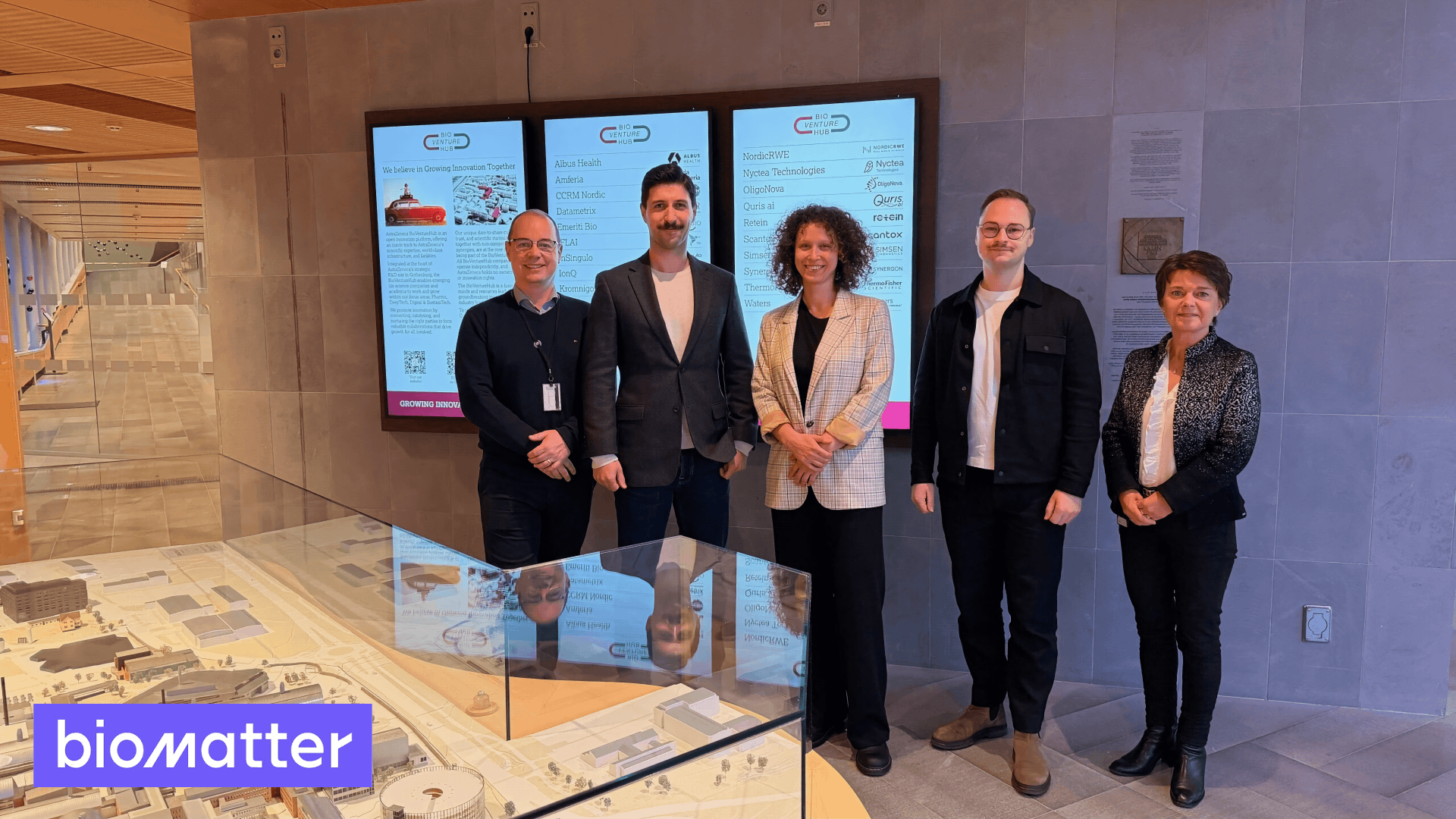
In January 2026, Biomatter took another interesting step by joining the AstraZeneca BioVentureHub in Gothenburg, Sweden.
It became the first company from Lithuania — and from the Baltic region more broadly — to join the industrial life-sciences R&D ecosystem.
That creates an interesting full circle in the Biomatter story.
Some of the company’s early generative protein-design work was experimentally validated through collaboration with Chalmers University of Technology in Gothenburg.
Several years later, the Vilnius-built company returned to the same city as a growing biotechnology business working alongside one of the world’s largest pharmaceutical companies.
Recognition for the underlying technology
In 2025, Laurynas Karpus, Vykintas Jauniškis and Irmantas Rokaitis were selected among ten global finalists for the European Patent Office’s Young Inventors Prize.
They were chosen from more than 450 candidates for their AI- and physics-based enzyme-design technology.
Earlier, Karpus, Jauniškis and Rokaitis had also appeared in Forbes 30 Under 30 Europe in the Science & Healthcare category.
But at this point, perhaps more important than the awards is the sequence of stages the technology has already passed through.
It began in a university laboratory.
It became a scientific paper.
It became patentable technology.
It became a company.
And it is now becoming commercial enzymes used in projects with international customers.
Proteins could become programmable technology
The biggest idea behind Biomatter is not really about a single enzyme.
It is about how biological technology may be created in the future.
A software engineer does not begin a new application by searching nature for a piece of code that roughly does what is required.
An engineer does not search for a naturally occurring machine part and then spend years trying to reshape it.
They start with requirements.
What must the system do?
Under what conditions must it work?
What properties does it need?
Then they design it.
Biomatter is betting that protein engineering is moving in the same direction.
Not:
find an enzyme that almost fits.
But:
design the enzyme that is needed.
If that becomes a reliable and repeatable process, the consequences could be extremely broad.
New pharmaceutical manufacturing processes.
More efficient diagnostics.
New food ingredients.
Cleaner chemical production.
Biological processes replacing energy-intensive industrial reactions.
And products that cannot be manufactured today simply because nature never had a reason to evolve the enzyme required to make them.
Designing biology in Vilnius that never existed in nature
In 2018, Biomatter was a small team of Vilnius scientists trying to answer a fairly fundamental question:
Can artificial intelligence create a new functional protein?
Today, the question has changed.
The company has international customers, close to €1.8 million in annual revenue, a team of more than 30 people, its own laboratory infrastructure and €6.5 million in fresh capital to expand the technology.
Its enzymes are already being used across health, food and industrial applications, while the company continues trying to shorten the path from a desired biological function to a real molecule.
That makes Biomatter more than simply another Lithuanian AI startup.
It is a company trying to do for biology what computer-aided design has done for many other areas of engineering:
learn to design something digitally before manufacturing it in the physical world.
Only in this case, the final product is not a chip, a building or a machine.
It is a molecular machine of life that may never have existed before.