
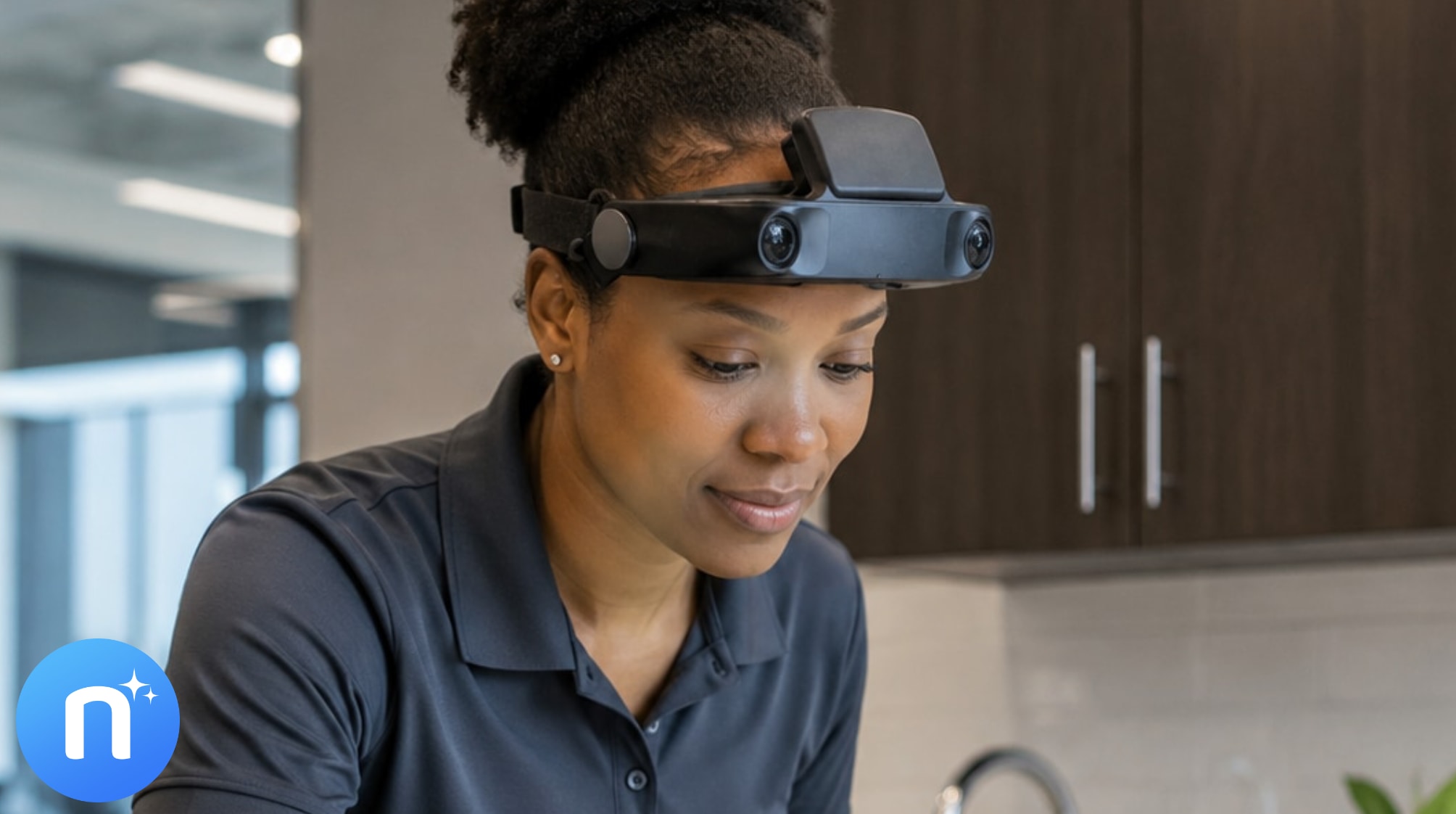
Most gig platforms make money in essentially the same way: somebody does the work, somebody buys the work, and the platform inserts itself between them and takes a percentage.
Nuuduu is trying something different.
The Kaunas-based startup is building a direct services marketplace where professionals can find customers, manage orders and get paid without surrendering a percentage of every job to the platform.
The idea is simple: the service transaction should belong to the customer and the professional.
Instead of building its business around commissions, Nuuduu plans to make money from something created alongside certain real-world service orders: high-quality training data for physical AI and robotics.
And when that data generates revenue, Nuuduu’s model is designed to share it with the people who made its collection possible — the professional doing the work and the customer providing the real-world environment.
The problem with the traditional gig economy
Digital marketplaces solved a real problem. They made it dramatically easier for customers to find workers and for independent professionals to find demand.
But the dominant business model created another problem.
When a platform earns a percentage of every transaction, its interests are not always aligned with the people actually performing the work. The platform benefits from higher commissions, greater control over transactions and keeping the relationship between customer and professional inside the platform.
Over time, a marketplace can begin to look less like infrastructure connecting two independent parties and more like an intermediary extracting a toll from every hour worked.
Nuuduu wants to separate those things.
A cleaner, electrician, technician or other professional using Nuuduu remains an independent service provider. The professional controls their services and pricing, while customers use the platform to discover, book and manage the work.
Nuuduu provides the digital infrastructure around that relationship rather than trying to become the employer sitting in the middle of it.
The more interesting question is therefore: if the platform does not need to maximise commission from the work, how does it build a valuable business?
Nuuduu’s answer is data.
Real work creates something increasingly valuable
The next generation of AI is moving from screens into the physical world.
Robots need to learn how people actually perform tasks: how an experienced cleaner approaches a bathroom, how a technician manipulates a tool, how objects are handled, how a task is planned, what happens when something unexpected occurs and how an experienced professional adapts.
This creates an enormous demand for real-world training data.
But Nuuduu does not believe the goal should simply be to build the biggest dataset.
It wants to build the best one.
That distinction changes how the marketplace is designed.
Nuuduu already knows what work was ordered, where it was performed, what the expected result was and which professional performed it. With the appropriate customer and professional permissions, an order can also become a structured data-collection opportunity.
That means training data does not have to come from actors repeatedly pretending to perform tasks inside a laboratory.
It can come from real professionals solving real customer problems in real environments.
Not every hour of work should become training data
If quality matters, simply putting cameras on as many people as possible is not enough.
Nuuduu’s approach is intentionally selective.
Before a professional can contribute training data, they need to demonstrate that they are experienced, appropriately qualified and in good standing on the platform.
The reasoning is straightforward.
If a robot is going to learn from human behaviour, the person demonstrating the task matters enormously.
An inexperienced worker can generate enormous quantities of video while demonstrating poor technique. An expert performing the same task may generate much less data, but the information contained in it can be considerably more valuable.
Nuuduu therefore sees professional reputation and marketplace history as part of the data pipeline itself.
Customer feedback, successfully completed work, professional experience and other quality signals can help determine whose work is suitable for training.
The marketplace is not merely a mechanism for finding people who can wear cameras.
It is a mechanism for finding people worth learning from.
The customer is part of the equation too
There is another scarce resource in physical AI training that is easy to overlook: access to the real world.
Homes, offices, workshops and commercial properties contain the disorder, variation and unpredictability that laboratory environments struggle to reproduce.
Objects are in different places. Equipment differs. Buildings age. Dirt accumulates. Lighting changes. People organise their homes differently. Something is broken. Something unexpected is blocking access.
These variations are precisely what robots eventually have to deal with.
But those environments belong to customers.
For Nuuduu, that means the customer cannot simply be treated as an invisible source of data.
Where a customer explicitly agrees to participate in training-data collection, they are contributing something economically valuable: access to the environment in which that data can be created.
Nuuduu’s planned model therefore shares training-data revenue with both sides of the original service transaction.
The professional contributes expertise and demonstration.
The customer contributes the real-world environment and consent.
Nuuduu provides the marketplace, collection infrastructure, permissions, context, processing and distribution necessary to turn the resulting material into a useful dataset.
When that data is sold, all three have participated in creating the product.
A marketplace becomes a data engine
This creates an unusual economic model.
A traditional gig marketplace looks at an eight-hour cleaning job and asks:
How much commission can we take from this transaction?
Nuuduu wants to ask a different question:
How valuable can the knowledge generated during those eight hours become?
The service itself can remain a direct economic relationship between customer and professional.
Meanwhile, selected and consented orders can produce a completely separate product for robotics and AI companies.
The result is potentially a very different incentive structure.
Nuuduu does not have to make the professional more expensive to the customer in order to increase its own revenue. It does not have to continuously increase the percentage extracted from the worker. And it does not need to prevent a productive long-term relationship developing between customer and professional.
Instead, the platform becomes more valuable when the people using it are more skilled, when customers trust it enough to participate and when the data generated through the network becomes better.
Context matters as much as video
Nuuduu’s advantage may also come from information surrounding the actual recording.
A video of somebody cleaning a kitchen tells an AI system something.
But a recording connected to an actual marketplace order can potentially tell it much more.
What did the customer request?
What was the professional expecting before arriving?
How long was the task expected to take?
What decisions did the professional make?
What tools were used?
What did the professional discover after arriving?
Was the work completed successfully?
How did the customer evaluate the result?
Nuuduu’s marketplace naturally generates this higher-level context because scheduling, communication, service descriptions and order management are already part of the transaction.
The long-term goal is therefore not simply to collect enormous quantities of egocentric video.
It is to connect what happened, why it happened, what was supposed to happen and whether an expert considered the outcome successful.
For training increasingly capable physical AI systems, that context may ultimately be as important as the pixels themselves.
Better data rather than more data
There is currently an understandable race to accumulate hours of robotics training data.
Nuuduu is making a different bet.
The company believes that provenance and quality will matter increasingly as datasets grow.
Who produced this demonstration?
Were they actually competent at the task?
Was this genuine work or a staged exercise?
What was the objective?
Do we know whether the task was completed correctly?
Do we have permission to use the data?
Can the behaviour be connected to the surrounding context?
Nuuduu wants every piece of training data to carry answers to questions like these.
The platform’s service marketplace is what makes that possible.
A different kind of gig platform
The unusual part of Nuuduu is that its marketplace and its AI-data business are not two unrelated ideas.
They depend on each other.
The marketplace creates real economic activity, attracts experienced professionals, establishes reputations, facilitates customer relationships and provides the context surrounding each job.
The data business creates a potential revenue stream that does not depend on taxing those transactions.
And the revenue-sharing model gives both professionals and customers a reason to participate in building something valuable beyond the original service.
If it works, Nuuduu would turn one of the central assumptions of the gig economy upside down.
The people doing the work would no longer primarily be the thing the platform monetises.
Their expertise would be.